Keeping it simple today. A poem by Theodore Roethke... abbreviated here for those with short little spans of attention.
The site where I found this poem also offered this Roethke quote:
"What we need is more people who specialize in the impossible.”
The Far Field
I dream of journeys repeatedly:
Of flying like a bat deep into a narrowing tunnel
Of driving alone, without luggage, out a long peninsula,
The road lined with snow-laden second growth,
A fine dry snow ticking the windshield,
Alternate snow and sleet, no on-coming traffic,
And no lights behind, in the blurred side-mirror,
The road changing from glazed tarface to a rubble of stone,
Ending at last in a hopeless sand-rut,
Where the car stalls,
Churning in a snowdrift
Until the headlights darken.
…
-- Or to lie naked in sand,
In the silted shallows of a slow river,
Fingering a shell,
Thinking:
Once I was something like this, mindless,
Or perhaps with another mind, less peculiar;
Or to sink down to the hips in a mossy quagmire;
Or, with skinny knees, to sit astride a wet log,
Believing:
I'll return again,
As a snake or a raucous bird,
Or, with luck, as a lion.
I learned not to fear infinity,
The far field, the windy cliffs of forever,
The dying of time in the white light of tomorrow,
The wheel turning away from itself,
The sprawl of the wave,
The on-coming water. …
A man faced with his own immensity
Wakes all the waves, all their loose wandering fire.
The murmur of the absolute, the why
Of being born falls on his naked ears.
His spirit moves like monumental wind
That gentles on a sunny blue plateau.
He is the end of things, the final man.
All finite things reveal infinitude:
The mountain with its singular bright shade
Like the blue shine on freshly frozen snow,
The after-light upon ice-burdened pines;
Odor of basswood on a mountain-slope,
A scent beloved of bees;
Silence of water above a sunken tree :
The pure serene of memory in one man, --
A ripple widening from a single stone
Winding around the waters of the world.
Monday, August 21, 2006


Sunday, August 20, 2006
Salt Marsh

For sometime I have been looking for a poem by James Dickey.
It begins with the line (as I recall): I sent you a bluebird by the name of Joe with Happiness tatooed on his left bicep and all you can say is you think the cat has got him...
I love that poem. If I had it, I'd share it here. But, I don't. Instead I found, Salt Marsh.
Marshes mean something to the Bralleys. The picture here is shot from my brother's deck. So, here is a poem for him and you, by James Dickey. And yes, that is a rainbow in the picture.
Once you have let the first blade
Spring back behind you
To the way it has always been,
You no longer know where you are.
All you can see are the tall
Stalks of sawgrass, not sawing,
But each of them holding its tip
Exactly at the level where your hair
Begins to grow from your forehead.
Wherever you come to is
The same as before,
With the same blades of oversized grass,
And wherever you stop, the one
Blade just in front of you leans,
That one only, and touches you
At the place where your hair begins
To grow; at that predestined touch
Your spine tingles crystally, like salt,
And the image of the crane occurs,
Each flap of its wings creating
Its feathers anew, this time whiter,
As the sun destroys all points
Of the compass, refusing to move
From its chosen noon.
Where is the place you have come from
With your buried steps full of new roots?
You cannot leap up to look out,
Yet you do not sink,
But seem to grow, and the sound,
The oldest of sounds, is your breath
Sighing like acres.
If you stand as you are for long,
Green panic may finally give
Way to another sensation,
For when the embodying wind
Rises, the grasses begin to weave
A little, then all together,
Not bending enough for you
To see your way clear of the swaying,
But moving just the same,
And nothing prevents your bending
with them, helping their wave
Upon wave upon wave upon wave
By not opposing,
By willing your supple inclusion
Among fields without promise of harvest,
In their marvelous, spiritual walking
Everywhere, anywhere.
Saturday, August 19, 2006
How We Practice

These Buddhas want it all from you.
Oh, they start out simply enough,
a little rice, a few sticks of incense.
But in the end, they’ll have it all
and you’ll be left with Emptiness.
And never happier.
This is their compassion.
*********
“I’m dying! and it’s killing me!” the thought explodes within me and I shake with sobs.
Then, another inner voice, “Well of course you’re dying. You’re alive, aren’t you?”
“Ah, the old half empty, half full?” I stop crying for a moment, breath suspended.
“Yes.” (That voice, so calm and smug.)
“No! I’m dying! and it’s killing Me!” I am sobbing once again.
Did this start when I first saw her picture?
Wasn’t it just yesterday when asked if I had heard from her, I had replied, “No! She said she wouldn’t and she hasn’t. And... she’s killing me!”
Ah. Yes. But that was simply round one.
“Tat Tvam Asi,” “I am That, Thou art That, All this is That” – one of the grand pronouncements of the Upanishads.
Now,This is That replayed one or two octaves higher.
Now, the Fat Lady’s singing.
This could be called “falling in love,” but more precisely I suspect it’s, “falling into Love.”
Forget that Hollywood version, this won’t be shown up on the big screen.
This is the Big Screen Itself, showing Itself.
The Self unfolds Itself, by Itself, to Itself- another one of those pronoucements.
This is what went on behind closed doors as Shams and Rumi locked themselves away for forty days. Shams was burning Rumi into Big Screen, Ocean, Absolute, God…
You name it.
I can’t be bothered.
“I’m dying! and it’s killing Me!”
… Silence is my only hope…
Instead, I must have played Johnny Cash a dozen times this morning.
“Love... is a burning thing... and it makes a firery ring.”
“I fell in to a burning ring of fire.
I went down, down, down and the flames went higher.
And it burns, burns, burns…”
Now, that was her doing!
And we're back to level one.
Falling in love is how we practice Falling into Love.
Falling in love is how we practice becoming Enlightened.
Those Buddhas want you to have it All.
Ru Ding

Since my move, you may be disappointed to learn that I have had to discontinue my early morning radio broadcast from the bathtub. (15 minutes of caffeine induced insight that reached an audience of 4, if you include cat & dog. )
And it’s just as well. Apparently, there are other issues now. No “News of the World Report” to report, only the retort of my own personal issues with the Infinite.
Is this me coming up against what Taoist, B.K. Frantzis, calls “ru ding?” Ru ding: the fear of the death of the ego that leaves one in shear terror? Frantzis describes his first encounter this way:
I was in Hong Kong, beginning to learn the old Yang style of Tai Chi Chaun when ru ding first struck me… It was late at night, at a still and quiet terrace on the Peak, where few people came after midnight…the park was quiet, and the moon and the sky felt as though they were descending downward, putting enormous pressure on every square inch of my skin, as I tried to life my arms with the expansive energy of tai chi…I felt as if Chi from the moonlight, stars, and sky penetrated my body against my will. My body and mind became immensely still, as though they had dropped into a bottomless abyss, even though I was doing the rhythmic slow motion movements…At the depth of the stillness, an overwhelming, formless fear began to develop in my belly…. Then it happened: an all-consuming, paralyzing fear seemed all at once to invade every cell in my body… I knew if I kept practicing there would be nothing left of me in a few seconds… I stopped practicing… and ran down the hill praying hard that this terror would leave me….
The ego, goes into a mortal fear when the false reality of being separate from the universal life force is threatened by your consciousness having reached an awareness of connection to everything in existence. The ego spews forth all sorts of terrifying psychological and physiological reactions in the body and mind to make meditators petrified of leaving the state of separation.
Frantzis says that ru ding is a stage each practitioner must go through. At a certain point, it is repeatedly encountered until you finally cease trying to avoid the pain, let go of all resistance, and let the ego disappear.
Though Frantzis is a Taoist, this annilation of the ego seems a Buddhist thing to me. Maharishi never taught of fear, pain, death. He spoke of the ego's expansion- the exact opposite. It was a step taken in the Light of celestial awareness. At a certain point, "Either I drop off or God drops off. Out of respect, we say, I drop off."
So experience, as always, seems determined by the path you take. Bernadette Roberts, coming from a Catholic tradition had a similar running, jumping in the car and fleeing that she recounts in her No Self writings.
The totally traditionless Eckhart Tolle, describes his experience when his ego finally let go in these words:
One night I woke up in the middle of the night, as I had many times before, in a state of even more intense dread and fear… It became so unbearable that suddenly the thought occurred to me, "I cannot live with myself any longer." That thought was the trigger for a transformation. The thought kept repeating itself many times in my head and then suddenly there was a stepping back from the thought and a looking at the thought. I asked, "Who is the 'I' and who is the self that I cannot live with?"
… it's almost as if a [Zen] koan spontaneously appeared in my mind. A koan's purpose is to destroy conceptual thinking because it has no answer on a conceptual level... At that moment the whole structure of the "unhappy me" and its pain collapsed because the withdrawal of identification was so complete. What was left was simply beingness or presence. There was still a moment of fear. It felt like being drawn into a hole within myself, a vast whirlpool, and a realization arose in my chest, "Resist nothing." That was the key. Then resistance was relinquished and I don't know what happened after that.
All I do know is that the next morning I woke up… I opened my eyes and everything was alive and new and fresh as if I had never seen it before. And I walked around and picked up things and looked at them. I was amazed at everything. There was no understanding of it. I was not even trying to understand anything. It was just so beautiful.
I have Held the Light at Bay

I have held the Light at bay for years. Avoided looking at the treetops, for that is where it resides waiting to descend. But, I didn't know that for some time. All I knew was that I could only glance up briefly. Such a cathedral, there in Nature, but lifting my eyes made me so dizzy, nauseated. I’d quickly look away.
Then one day, I decided to just see. What was this? Why couldn’t I just look? One day, I refused to look away.
What happened next had never crossed my mind as even possible.
Instantly a flood of Light streamed down from above into my head until I staggered back. I knew immediately the Light was, for lack of better appellage, “God.”
Jesus! And this is the park across from where I work? I’m on a noonday walk for God’s sake, not Saul on some road to Damascus or wherever.
For God’s sake...
...I will have to learn to breath more deeply. I will have to learn how to let that Light in and then right on out through the bottom of my feet.
But, that day I couldn’t pull it off.
Instead, I developed migraines.
Sometimes, I've felt like some human version of a ship’s mast buzzing with St. Elmo’s Fire. As if a bolt of Light had struck my head, and then just resonated there unable to drain off.
My cat took to sleeping on my head. At night I felt like Davie Crockett in his coonskin hat, but I hoped Eddie would suck some of the energy off.
This may be how ru ding began for me.
This may be the Yang (or Light) version of the black Yin abyss described by Frantzis and Tolle.
The abyss came later.
Exhausted from unconscious efforts, I still did not understand how much I held at bay. Then lying in bed one night I began wondering, “Why am I so tired? Day after day, I am so tired.”
Well, there it was.
Almost by accident I noticed a small dark gray circle. Right there in front of me, about eight inches from my face, four inches above my forehead.
"How strange... What is that?”
I could feel the energy, the constant effort I had been applying to that spot. It was almost like I had been straight-arming it day after day and never noticed. And, it was taking tremendous effort. So, I stopped.
And in that moment the Void leapt out and swallowed me.
Or, was it I who swallowed It? There was this inversion inwards. And I was falling, faster, faster. Rushing, I was letting go into Annihilation and I craved it.
"Take it!
"Take it all!
"It means nothing!"
And then I thought of her. And terror grabbed me. "If I die I lose her!" And I sat up in the bed, turned and clung to her.
Now, she’s long gone and I am in the bathtub coming to the obvious.
Life has led me to this point.
Along the way I have become both scientist and mystic.
A mystic: someone who's direct experience reveals a reality totally denied by science.
A molecular biologist: someone who naturally conceives of reality in terms of billiard ball cause and effect- the ultimate materialist.
It has taken years to be able to stand with one foot in each of these contradictory row boats and not get dumped into the water. Now, I am matured. Ready for the implications.
Then, suddenly there was that scream.
“I’m dying! and its killing Me!”
Every cell within me dying into nothingness.
Was it Rumi who said you can tell a mystic by the burn marks on their face?
Well, my face is reasonably intact, but my body’s taken quite a beating.
People say, “You’re losing weight!”
The migraines took off thirty pounds in three months. And the doctors still found nothing.
I shrug. What can I say? “No, I have not been on a diet.”
But, it is becoming clear.
There will be nothing left when I am done.
It will all be burnt away.
Not that it really matters.
Some days are solid, Immovable.
Some days there is such deep laughter; a secret laughter that doesn’t ever stir upon my face. That makes it all the more delicious: this deep, deep laughter that can only escape out through my eyes...
Or, by saying something like I have a radio broadcast that I do each morning from the bathtub. Silly... You’d get electrocuted!

Friday, August 18, 2006
Down upon the Sands
My father would have been 90 today.
For his 80th birthday (and 50th anniversary) we had a family reunion at the beach. Shortly after his arrival my brother and I stood before a picture window with him as he surveyed the new surroundings. Kiawah’s sands stretched before us.
.
“Oh! It’s beautiful,” he said. “I thought it’d be a crummy little thing.”
We all laughed and Andy slapped him on the back, “Pop, we wouldn’t do that to you!”
(I think Pop had misconstrued the literature I’d sent him that touted “outside showers on the beach,” when he really preferred indoor plumbing.)
At that moment, none of us suspected in the least that in less than 24 hrs Pop would be lying dead upon those sands. But, that’s how events unfolded.
Not that life was cruel. On the contrary, he and mom walked hand in hand at sunrise on the day he died. His entire family was gathered round him within minutes of his collapse. And since there were other doctors there, my sister could be simply a daughter and not responsible for resuscitation efforts. Most of all, we had a week to simply hole up together, as we seldom are, waiting for his ashes to be returned.
Still, what sticks in my mind most vividly are those words, “Oh, It’s beautiful. I thought it’d be a crummy little thing.”
I know that he was talking real estate, but I cannot shake the feeling that he was summing up his life. And I wonder how many of us are guilty of the same misapprehension - And how many of us will wake up to the beauty before we lie down upon the sands?

For his 80th birthday (and 50th anniversary) we had a family reunion at the beach. Shortly after his arrival my brother and I stood before a picture window with him as he surveyed the new surroundings. Kiawah’s sands stretched before us.
.
“Oh! It’s beautiful,” he said. “I thought it’d be a crummy little thing.”
We all laughed and Andy slapped him on the back, “Pop, we wouldn’t do that to you!”
(I think Pop had misconstrued the literature I’d sent him that touted “outside showers on the beach,” when he really preferred indoor plumbing.)
At that moment, none of us suspected in the least that in less than 24 hrs Pop would be lying dead upon those sands. But, that’s how events unfolded.
Not that life was cruel. On the contrary, he and mom walked hand in hand at sunrise on the day he died. His entire family was gathered round him within minutes of his collapse. And since there were other doctors there, my sister could be simply a daughter and not responsible for resuscitation efforts. Most of all, we had a week to simply hole up together, as we seldom are, waiting for his ashes to be returned.
Still, what sticks in my mind most vividly are those words, “Oh, It’s beautiful. I thought it’d be a crummy little thing.”
I know that he was talking real estate, but I cannot shake the feeling that he was summing up his life. And I wonder how many of us are guilty of the same misapprehension - And how many of us will wake up to the beauty before we lie down upon the sands?
Thursday, August 17, 2006
Enligtenment's a Gamble
A poem by Adyashanti regarding enlightenment. But, it's just as true for Love, I do believe.
Time to cash in your chips
put your ideas and beliefs on the table.
See who has the bigger hand
you or the Mystery that pervades you.
Time to scrape the mind's shit
off your shoes
undo the laces
that hold your prison together
and dangle your toes into emptiness.
Once you've put everything
on the table
once all of your currency is gone
and your pockets are full of air
all you've got left to gamble with
is yourself.
Go ahead, climb up onto the velvet top
of the highest stakes table.
Place yourself as the bet.
Look God in the eyes
and finally
for once in your life
lose.

Time to cash in your chips
put your ideas and beliefs on the table.
See who has the bigger hand
you or the Mystery that pervades you.
Time to scrape the mind's shit
off your shoes
undo the laces
that hold your prison together
and dangle your toes into emptiness.
Once you've put everything
on the table
once all of your currency is gone
and your pockets are full of air
all you've got left to gamble with
is yourself.
Go ahead, climb up onto the velvet top
of the highest stakes table.
Place yourself as the bet.
Look God in the eyes
and finally
for once in your life
lose.
Sunday, August 13, 2006
Stranded on the Tarmac
Recently, I received an email filled with marvelous questions. I thought I’d share the discussion here. Rebecca began with a great juxtaposition:
I'm stranded on a tarmac at the Atlanta airport waiting on a flight to Louisville (and it's hard to concentrate as the men behind me are talking loudly about deer hunting) but I was interested in your description of bacteria getting to the top of one evolutionary mountain. The bacteria are living the good life - only to find themselves in the valley at some later point.
(see August 9th: Evolution is a walk across a rugged landscape)
I was applying that to some sales training I've recently become involved in. I work in human resources for a furniture store - and retail sales people are really cut throat. They can be top of the heap one month - but if they don't continuously change their tactics - and evolve to the customer's ever changing demands, they soon find themselves in the valley of low sales and low commissions, making them unhappy - which makes them start to feed on one another- which is where I, as a human resources person, come into the picture.
All of this was really interesting to me - but then your statement at the end regarding how important meditation is as a way for evolving our consciousness really caught me off guard!
I've never thought about the possibility of evolving one's consciousness! I suppose I've been of the belief that consciousness is something you are born with that remains a constant underlying hum. One's personality and likes/dislikes change all of the time - but consciousness to me seems like the basic foundation of one's person. That sort of consciousness seems like a grand, eternal - and people either have it or they don't.
PB: Yes, it is a constant and we all have it. It’s been called Pure Consciousness, since it is consciousness itself without an object of perception. It is the screen upon which the movie of life flickers.
What can evolve with time is the ability to see the screen more and more clearly. This is a direct experience and profoundly different from an intellectual understanding. It’s as if Consciousness is suddenly a succulent mango popped into your mouth, where before you’d only read about them.
As a consequence, how you express consciousness in your life changes. You’ve upgraded the movie screen to an IMAX, and the movie going experience jumps to another level.
For example, you are an incredible poet…now. But just a few years ago you didn’t write. (see Rebecca’s Website for her poems)

I'm stranded on a tarmac at the Atlanta airport waiting on a flight to Louisville (and it's hard to concentrate as the men behind me are talking loudly about deer hunting) but I was interested in your description of bacteria getting to the top of one evolutionary mountain. The bacteria are living the good life - only to find themselves in the valley at some later point.
(see August 9th: Evolution is a walk across a rugged landscape)
I was applying that to some sales training I've recently become involved in. I work in human resources for a furniture store - and retail sales people are really cut throat. They can be top of the heap one month - but if they don't continuously change their tactics - and evolve to the customer's ever changing demands, they soon find themselves in the valley of low sales and low commissions, making them unhappy - which makes them start to feed on one another- which is where I, as a human resources person, come into the picture.
All of this was really interesting to me - but then your statement at the end regarding how important meditation is as a way for evolving our consciousness really caught me off guard!
I've never thought about the possibility of evolving one's consciousness! I suppose I've been of the belief that consciousness is something you are born with that remains a constant underlying hum. One's personality and likes/dislikes change all of the time - but consciousness to me seems like the basic foundation of one's person. That sort of consciousness seems like a grand, eternal - and people either have it or they don't.
PB: Yes, it is a constant and we all have it. It’s been called Pure Consciousness, since it is consciousness itself without an object of perception. It is the screen upon which the movie of life flickers.
What can evolve with time is the ability to see the screen more and more clearly. This is a direct experience and profoundly different from an intellectual understanding. It’s as if Consciousness is suddenly a succulent mango popped into your mouth, where before you’d only read about them.
As a consequence, how you express consciousness in your life changes. You’ve upgraded the movie screen to an IMAX, and the movie going experience jumps to another level.
For example, you are an incredible poet…now. But just a few years ago you didn’t write. (see Rebecca’s Website for her poems)
Evolve or Die?

RF: Do you think the statement "evolve your consciousness or die" would also apply?
PB: Yes, I think that this is very true- on several levels. I think that as a species it applies most crucially. And changing the consciousness of the species depends upon changing the individuals of that species.
RF: Maybe "dying" in that context would be more of a metaphor (a lost opportunity - the death of the ability to take full advantage of one's precious human birth). Or maybe it’s a kind of zombie death where the person doesn't realize they are in fact fading away more and more every day, until consciousness becomes completely about how familiar they are with the latest celebrity breakup!
PB: Yes! That is another level also. Compare a poet to a couch potato. Is one more alive or conscious than the other? I think so.
RF: Do you think meditation is the only way to evolve one's consciousness?
PB: No. We are growing, learning all the time. Children needn’t meditate. As their nervous systems mature they acquire language, self reflection, empathy and many more abilities.
There are different forms of yoga to directly experience Pure Consciousness, each tailored to the different nature of people. For example, there is karma yoga (involving action), gyana yoga (for those given intellectual analysis), bhakti yoga (for cultivation of the heart and devotion), raja yoga (or Royal yoga involves meditation).
The important point, to me, in this regard is that meditation represents the quickest, most efficient way to evolve consciousness.
What I didn’t get to the other day was how life continues to evolve its ability to evolve.
Bacteria need to change their genes to evolve. Most simply, this involves a mutation at a single point. But, each of biology’s so called “major evolutionary transitions” has involved inventing a new way to evolve. The multi-cellular organism is one such invention. These organisms have new talents, in addition to the old. For example, Indian corn gets its many colored kernels because plants have evolved so called “jumping genes.” These genes can jump (all by themselves) to new places in the chromosome. Sex, another great invention, allows mixing of entire chromosomes. Language, another major transition, represents a huge jump for consciousness.
I think meditation fits nicely into this grand view of evolution. It is simply the latest opportunity to evolve our ability to evolve. I’m not using analogy or metaphor here.
On the level of species these changes are called evolution. On the level of the individual changes are called development. So, the time frame is changing and the mechanisms of evolution are changing. Today, to “evolve” or “develop” from fertile egg to adult requires one thing: turning genes on and off in an orchestrated manner. I often think of development as some great musician sitting at this huge pipe organ in some cathedral, pulling stops in and out and pumping all the petals. That’s what our cells do each day of our lives as we develop from embryo, to child, to adult, to withered elder.
And at this point, we don’t need mutations creating new genes. We’ve got the full genetic complement to become enlightened. That anyone ever got enlightened is "proof of principle." What we need to do now is pull the stops out correctly for playing the new music. Some genes need to be turned off, or down, others need to be turned on, or turned up in a new combination from what we usually see. That’s what meditation is for. That's what meditation does more effectively than any technique that I know.
Friday, August 11, 2006
Something is a Foot!

So, this morning I was sitting on my back deck having my morning eggs and refried beans and trying to figure out just what the heck is going on in my life!
I have no idea. But, something is a foot! Of this I am sure. And it is BIG. And it is quite a ride.
That’s when I realized…
“Something is a foot when it is the Hand (of God) .”
Well, I got a kick out of that and thought I’d pass it along.
Get it? It’s a foot… it’s a hand…!?
That’s funny!! (I think.)
Ok. I can see you’re not getting it.
So, here. Try this…
So this horse...

So this horse walks into a bar. Goes up to the bartender, the bartender takes one look at him and says, “Oh my, why the long face?”
Now, do you get it?
That’s funny! A horse… a long face?
That's just silly, you say? Well, Yes!
But, how often do we try to make a problem out of what’s simply the nature of things?
Now, that’s silly.
Enlightenment involves a lot of lightening up.
And next time something is a foot… count your blessings.
(I had a great long faced horse picture in mind for this spot, but at the last moment, turned out I couldn't blog it. SO, the horse had to be a dog. Well, now, maybe that's just perfect!)

Thursday, August 10, 2006
Kiki Booba, Geographical Conditions and Sacred Language
I’ve been thinking about the Shenandoah Valley. The first time I drove through it I was struck by such a sense of coming home. The Bralley’s are multigenerations there, but I had never been. And even as a budding scientists, I knew that memory cannot be inherited. Still, I was amazed by how I felt. My eyes loved the lines and soft contours. Such a softness. It invited me to stop even as the song, “Country Roads” started in my head and wouldn’t stop.
This is not the “Colorado Rocky Mountain High” of which John Denver also sang. It is the antipode. One is crystal electricity, the other a warm cellular salinity.
Geography gets into our bodies and from there into our souls, and from there onto our tongues. Maharishi first pointed this out to me. He said that geographical conditions affect consciousness to the extent that people have to speak a bit differently in different regions so that the message can get through.
New Orleans, will lull you right to sleep as it sucks the tension out of every tendon. And they have this draw and roll there and they can spin a story out slowly, easily so that you almost don’t have to really pay attention. It’s more like lying there as Eudora Welty takes a finger and slowly twists the hair upon your head into long, loose, draping curls.
But in the Birtish Isles, it’s all, “I say!” “Bravo!” “Hip, Hip!” I suppose it's all that air sweeping down from the North Sea. Things have a crispness and an edge.

This is not the “Colorado Rocky Mountain High” of which John Denver also sang. It is the antipode. One is crystal electricity, the other a warm cellular salinity.
Geography gets into our bodies and from there into our souls, and from there onto our tongues. Maharishi first pointed this out to me. He said that geographical conditions affect consciousness to the extent that people have to speak a bit differently in different regions so that the message can get through.
New Orleans, will lull you right to sleep as it sucks the tension out of every tendon. And they have this draw and roll there and they can spin a story out slowly, easily so that you almost don’t have to really pay attention. It’s more like lying there as Eudora Welty takes a finger and slowly twists the hair upon your head into long, loose, draping curls.
But in the Birtish Isles, it’s all, “I say!” “Bravo!” “Hip, Hip!” I suppose it's all that air sweeping down from the North Sea. Things have a crispness and an edge.
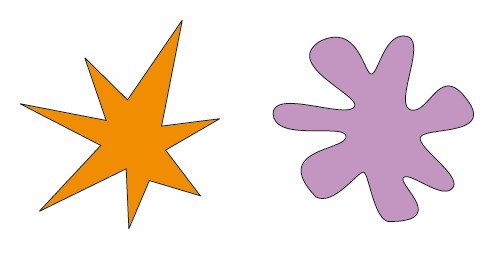
Which brings me to Kiki BooBa and sacred language.
Language is sacred by virtue of the correlation maintained between name and form. And in the sacredness lies the power of mantra and poetry. (see Sacred Language, June 21, 2006 ) By contrast, we speak in ordinary tongues of Natural language which are understood by definition to be “arbitrary” – i.e. lacking any relationship between name and form.
Well, Kiki Booba is a bit of evidence that even Natural languages have just a hint of name and form. (And maybe elsewhere I will argue that it’s evidence for sacred language actually existing.) Kiki Booba goes like this……
A remote tribe calls one of the shapes I’ve shown above Booba and the other Kiki. Decide which is which and then read on.
This is a test to demonstrate that people may not attach sounds to shapes arbitrarily. In a psychological experiment first designed by Wolfgang Köhler 95% to 98% of people choose Kiki for the orange angular shape and Booba for the purple rounded shape.
It now appears that during language development the naming of objects is not completely arbitrary. “The rounded shape may most commonly be named Booba because the mouth makes a more rounded shape to produce that sound. Similarly a more taut, angular mouth shape is needed to make the sound Kiki. The sounds of a 'K' are harder and more forceful than those of a 'B', as well. Note also that, in the Roman alphabet, the angular shape mimics the angular letters K and I, while the rounded shape mimics the rounded letters B and O." (Wikipedia)
Now, this was interesting to me and I’ll get back to it one day in detail. For, I think it can be tied into what happens during meditation and during speaking in tongues. Consciousness expands and we regress to the semi-sacred correlation of name and form found in glossolalia (speaking in tongues).
But that’s enough for now. I find, I’d rather just enjoy a bit of Kiki Booba. I find together there’s a dance, a celebration going on.
Kiki Booba, isn’t he the leader of a Carribean band?
Or should I be content with French Chanson’s effect even sans translation?
Oh My Gosh!

KiKi Booba, Indeed. I don't always understand this woman.
But, tickle my chin and I babble French too. And it makes you want to hug me, doesn't it.
Wednesday, August 09, 2006

Jiffy Lube and Life

When my partner of twenty years and I split up, I had this image in my head that my future lay across a series of mountain ranges. It was so clear to me, like one of those pictures shot from the summit and published in The National Geographic magazine. Hill after hill, range upon range and I knew that when I reached the other side, we would meet again. The only thing was, I would be so changed by my journey as to be physically unrecognizable. So would she. Was it a lifetime or life times that would pass? I did not know the answer, only that we would meet again and our souls would recognize and rejoice in “the familiar.”
Our love would last, but for now our paths were parting. And on her way out the door, oblivious to metaphor, she said, “Be sure to get your oil changed.”
She had been worrying on that for days and hadn’t had the time to attend to it. “Don’t worry. I’ll get it changed,” I assured her, though my intentions were to walk, walk that is across those mountains which were my more immediate concern.
Well, I am in a new house now, moved to a new neighborhood. And yesterday in the mail there was this card from Jiffy Lube, “We haven’t seen you in awhile.”
In fact, it had been 6 months or 6000 miles. It felt to me more like the latter, six thousand miles across the mountains. And again I saw that image, the progress made, the distant horizon still unmet- but my feet weren’t even bleeding.
I smiled. Six thousand miles!
Now, I bring all this up because there is a lesson here. While you might say that, yes, it’s a nice metaphor regarding the struggles in life and how life’s one grand adventure… yah dah, yah dah - it goes deeper than just that. It is, I believe, a deeply intuitive take into the laws of nature, or more specifically, the nature of evolution.
Evolution is a walk across a rugged landscape.

“Evolution is a walk across a rugged landscape,” that’s what theoretical biologists (the guys who crunch the numbers) would say.
Well, what the hell have I been doing? Heck, you can still be in a relationship and feel the muscle burn from climbing up and down.
“Evolution is nature's way of solving problems.” That’s another thing theoretical biologists argue. Of course, they’re not aiming at domestic tranquility with this point. For Biology, the main problem for a bacterium (or anybody else) is how to survive long enough to reproduce. This is the arena of survival of the fittest and natural selection, where genetically distinct individuals compete for limited resources. Those that do best produce more offspring.
Again, you say there's no connection here to working out a long term relationship… But wait there is. Because, as perfectly fit individuals do well, and are fat and happy in their little ecological niche, things change.
AH yes, “We were doing so well and then things changed.” It happens to even the most fit organism. For no environment is stable. Sooner or later everything will change. And then what happens? How does evolution cope with a moving target?
The rule is, “Evolve or Die.” And if you haven’t read the headlines on the emergence of antibiotic resistance, let me tell you, bugs are great at doing this. They manage to evolve quickly, and find new genetic solutions.
Faced with a changing environment (and who isn't), bacteria explore a vast range of alternative genetic solutions. Theoretical biologists have created a model to map out this behavior. They call it an "adaptive landscape," or better yet a "rugged landscape." It's a metaphoric tool to describe this genetic prospecting; an abstract mathematical space with an undulating surface of hills and valleys.
The height of any point on this landscape corresponds to the genetic fitness of an organism to its environment. The highest peaks represent those genetic combinations which produce the highest fitness. Movement on the landscape corresponds to changes in the organism's genetic constitution- changes made as it evolves and seeks to survive and reproduce.
Fuelled by mutation and driven by natural selection, organisms will tend to march uphill toward fitness peaks and once there hunker down to enjoy the good life... until conditions change. Suddenly, they’re no longer fit. They are thrown into a deep valley and have to begin again that evolutionary walk. If they don’t, they die.
They die right there in the pits. Now, tell me, is this not a great metaphor for relationships? Is it not more than a romantic image? There is mathematics here. (In fact, given that a bacterium has about 4000 genes, a true adaptive landscape is a space of 4000 dimensions… Don’t try to go there, it will not help.)
The take home message here is simple. What’s true for a bacterium surviving in the gut, is not that different from two people trying to survive in a relationship. Or for that matter, economists have applied this knowledge to innovation in business. And, I think it also applies to our surviving on the planet.
If you what to survive long enough to blossom, if you want to live a life truly suited to your surroundings- you must evolve or die.
And despite the impression one may receive from the media, meditation is not simply a means to reduce stress. Meditation is about one thing ultimately- it is a means, perhaps the best we have, to evolve our consciousness.
Sunday, August 06, 2006
They weren't sure...

They weren't sure if they had missed the boat, or if it hadn't arrived yet.
Originally uploaded by BosseB.
Missing the Boat
Either all the world religions are wrong, and saints through-out history were merely hallucinating, or we are really missing the boat.
What I’m trying to do here is argue for the latter.

What I’m trying to do here is argue for the latter.
Thursday, August 03, 2006
Déjà vu
In the last week I have been peppered with a number of episodes of déjà vu. I can go months without such an experience and now, here comes a cluster. These experiences seem like strange little wake-up calls. “What’s going on?” or “Whoa! … Déjà vu!” You know immediately, it is not possible, and yet something feels so real. Just beyond your grasp lies familiarity… I did this before… Yet, something does not compute: It seems like it was in the past… And that simply is impossible.
So what is going on here? Personally, it always makes me wonder about time and parallel universes and whether sometimes you “tune in” to the other time or place by remembering. But, these are just my own personal feelings. Surely, this can’t be. Though, time and parallel worlds leave room perhaps for that interpretation. Let’s be more hard headed here.
Science offers a variety of explanations which include: two cognitive processes momentarily out of synchrony, temporal lobe epilepsy disrupting neuronal transmission, problems in attention, and memory malfunction.
In these hypotheses the neuroscientists are arguing that specific zips of energy around and through the brain are not working quite as they normally do. And so, we feel and think a bit differently than usual.
But explication of neuro-circuits is just going for the answer to what’s been called the “Easy Question” regarding consciousness. For even if we knew the exact circuits, cells and anatomy involved in déjà vu, we would not have answered the “Hard Question”- how do these solid objects: electricity, molecules and cells create the immaterial memory. Déjà vu is a subjective experience, a totally personal and private feeling which no outsider can ever really access and thus, by definition this experience and every other act of consciousness cannot be an object. That’s the Hard Question. How does the material ever give rise to the immaterial?
Estimates for settling the easy question have been given at 100 years. As for the Hard Question, no one has even ventured a guess. Too many mysteries lie unsolved. Still, answering the Easy Question may provide insight into the Hard.
To me, invoking the function of specific neural circuits for specific experiences of consciousness (e.g. Déjà vu) is the equivalent of identifying the optics necessary for perception of the world around us. There are an array of devices out there to help us see more than we might. We need sun glasses in the sun, reading glasses for the written, telescopes to discern the rings of Saturn, and microscopes to see bacteria. Otherwise, we see nothing due to glare, blurred vision, distance, or small scale.
Devices are necessary to attune our eyes to the correct wavelength. Once outfitted correctly, whole new worlds can then be seen. Similarly, we need different neuro-circuits to perceive different realities of consciousness. It’s a good working hypothesis. Not mine, but that of cognitive science as a whole. And it is part of answering the Easy Question.
What I wonder is how far can we stretch this? How many circuits and new combinations there of are we allowed. How many realities do we get to see? Or in the case of déjà vu, remember.

So what is going on here? Personally, it always makes me wonder about time and parallel universes and whether sometimes you “tune in” to the other time or place by remembering. But, these are just my own personal feelings. Surely, this can’t be. Though, time and parallel worlds leave room perhaps for that interpretation. Let’s be more hard headed here.
Science offers a variety of explanations which include: two cognitive processes momentarily out of synchrony, temporal lobe epilepsy disrupting neuronal transmission, problems in attention, and memory malfunction.
In these hypotheses the neuroscientists are arguing that specific zips of energy around and through the brain are not working quite as they normally do. And so, we feel and think a bit differently than usual.
But explication of neuro-circuits is just going for the answer to what’s been called the “Easy Question” regarding consciousness. For even if we knew the exact circuits, cells and anatomy involved in déjà vu, we would not have answered the “Hard Question”- how do these solid objects: electricity, molecules and cells create the immaterial memory. Déjà vu is a subjective experience, a totally personal and private feeling which no outsider can ever really access and thus, by definition this experience and every other act of consciousness cannot be an object. That’s the Hard Question. How does the material ever give rise to the immaterial?
Estimates for settling the easy question have been given at 100 years. As for the Hard Question, no one has even ventured a guess. Too many mysteries lie unsolved. Still, answering the Easy Question may provide insight into the Hard.
To me, invoking the function of specific neural circuits for specific experiences of consciousness (e.g. Déjà vu) is the equivalent of identifying the optics necessary for perception of the world around us. There are an array of devices out there to help us see more than we might. We need sun glasses in the sun, reading glasses for the written, telescopes to discern the rings of Saturn, and microscopes to see bacteria. Otherwise, we see nothing due to glare, blurred vision, distance, or small scale.
Devices are necessary to attune our eyes to the correct wavelength. Once outfitted correctly, whole new worlds can then be seen. Similarly, we need different neuro-circuits to perceive different realities of consciousness. It’s a good working hypothesis. Not mine, but that of cognitive science as a whole. And it is part of answering the Easy Question.
What I wonder is how far can we stretch this? How many circuits and new combinations there of are we allowed. How many realities do we get to see? Or in the case of déjà vu, remember.
Déjà vu , Memory and Meditation

“I did this before.”
“This already happened.”
These are statements of memory. And a neural circuit explanation of déjà vu runs like this: a hyper-activation of the parahippocampal gyrus (now, don’t worry about what that exactly is, just enjoy the poetry)… a hyper-activation of the parahippocampus… gives rise to feelings of familiarity, a type of memory. Then, a normally functioning prefrontal cortex and hippocampus kick in to report “no content” in episodic memory. Thus, arises déjà vu. “Nothing there” in memory means it cannot be. But, it still seems very familiar. It’s a simple malfunction as two different types of memory are out of sync.
But, I’d like to drop the neurological and stick with just the warm and fuzzy world of memory per se. For, it seems to me that meditation itself can be approached almost entirely through the lens of memory. So, I’ve been thinking about memory for some time.
Meditation seems to bring up all kinds of memories. Novices sit to meditate and think about what happened in the day. More advanced practitioners often stir up traumatic memories from childhood. And of course, meditators are big believers in reincarnation. They’ll tell you all kinds of stories of what they’ve recollected. Do we really have memory back that far? And finally, Enlightenment itself is sometimes couched in terms of a wonderful sense of finally “coming home.” Is this just another version of familiarity, a memory writ large by hyper-activation of the parahippocampal gyrus?
Can many, if not most, experiences of meditation be ascribed to dysfunction in memory? I think it’s worth consideration.
First, it’s good to realize that there are many kinds of memory. Classification schemes abound. Based upon duration, there are three distinct types of memory: sensory, short-term, and long-term memory. Working memory, a type of the short-term, is defined not by duration but rather purpose.
Long-term memory encompasses both declarative (explicit) and procedural (implicit) memory. Declarative memory requires conscious recall and can be further sub-divided into semantic memory (which concerns facts independent of context) and episodic memory (which concerns information specific to context.) This includes personal memories, sensations, and emotions. Brain regions such as the hippocampus, the amygdala, and the mammillary bodies are involved in these different types of memory.
On the other hand, procedural memory (or implicit memory) doesn’t depend on conscious recall, but rather on implicit learning. It is used primarily in learning motor skills and is revealed by improved performance of a task after repetition. "Practice makes perfect" as we unconsciously learn by previous experience. Procedural memory depends upon the cerebellum and basal ganglia.
In the lab, each of these types of memory are separate functional units. One can be manipulated without affecting the function of the other. And too, notice that this whole scheme still leaves out at least two types of memory: familiarity and prospective memory (i.e. remembering to remember). So, even this complicated a scheme isn’t the whole story of memory, but it gets me to my point:
What this suggests to me is that memory, like reading glasses, telescopes and microscopes, comes in many forms suited to different functions. And while I think that déjà vu may actually be simply a memory malfunction, certain experiences in meditation may not. Neither dysfunctions or hallucinations, the memories uncovered during meditation may actually be hints that there is more to Reality than what the general consensus believes. Perhaps we have yet to uncover the full power and scope of human memory capacity.
What’s needed is veridical evidence. I'll suggest some things another day. For now, I would simply like to encourage the young scientists out there stay open to possibilities. And start looking not “out,” but “back and in.” It may well help us address the long denied Hard Question.
Wednesday, August 02, 2006
Is that a Smile?
I don't have any thoughts to put down here today. So, I thought I'd pass along a little "wide mouth frog." It's a photo by a fellow I know only as RupertG. He has recommended to me the book, "Two Views of the Mind." It's a Zen and science thing he thought I'd like. Looks good. Haven't read it. Frogs don't have much gray matter, i.e. no neo-cortex.
And some days, I am a frog.
I just wish that we could bottle this and send some to the Middle East.
You might also enjoy other photos by RupertG. Just click on froggie's face.

And some days, I am a frog.
I just wish that we could bottle this and send some to the Middle East.
You might also enjoy other photos by RupertG. Just click on froggie's face.
Thursday, July 27, 2006
Thinking
“Nothing remains the same for very long. The mind wants everything to stop so that it can get its foothold, find its position, so it can figure out how to control life. Through the pursuit of material things, knowledge, ideas, beliefs, opinions, emotional states, spiritual states, and relationships, the mind seeks to find a secure position from which to operate.
The mind seeks to nail life down and get it to stop moving and changing. When this doesn't work, the mind begins to seek the changeless, the eternal, something that doesn't move. But the mind of thought is itself an expression of life's movement and so must always be in movement itself. When there is thought, that thought is always moving and changing.
There is really no such thing as thought. There is only thinking, so thought which is always moving (as thinking) cannot apprehend the changeless. When thought enters into the changeless it goes silent. When thought goes silent, the thinker, the psychological "me," the image-produced self, disappears. Suddenly it is gone….
You are now no longer the thought, nor the thinker, nor someone who is aware. Only awareness remains, as itself. Then, within awareness, thought moves. Within the changeless, change happens. Now awareness expresses itself. Awareness is always expressing itself: as life, as change, as thought, feelings, bodies, humans, plants, trees, cars, etc. Awareness yields to itself, to its inherent creativity, to its expression in form, to experience itself. The changeless is changing. The eternal is living and dying. The formless is form. The form is formless. This is nothing the mind could have ever imagined.”
~ Adyashanti Copyright ©2003 by Adyashanti. All rights reserved.
Too much Thinking!
So, why do I bother with this blog?
Let’s call it encouragement… for me, for you…
So, let’s take a bow. And proceed.
Let’s think about some things, because that’s what scientists do.

The mind seeks to nail life down and get it to stop moving and changing. When this doesn't work, the mind begins to seek the changeless, the eternal, something that doesn't move. But the mind of thought is itself an expression of life's movement and so must always be in movement itself. When there is thought, that thought is always moving and changing.
There is really no such thing as thought. There is only thinking, so thought which is always moving (as thinking) cannot apprehend the changeless. When thought enters into the changeless it goes silent. When thought goes silent, the thinker, the psychological "me," the image-produced self, disappears. Suddenly it is gone….
You are now no longer the thought, nor the thinker, nor someone who is aware. Only awareness remains, as itself. Then, within awareness, thought moves. Within the changeless, change happens. Now awareness expresses itself. Awareness is always expressing itself: as life, as change, as thought, feelings, bodies, humans, plants, trees, cars, etc. Awareness yields to itself, to its inherent creativity, to its expression in form, to experience itself. The changeless is changing. The eternal is living and dying. The formless is form. The form is formless. This is nothing the mind could have ever imagined.”
~ Adyashanti Copyright ©2003 by Adyashanti. All rights reserved.
Too much Thinking!
So, why do I bother with this blog?
Let’s call it encouragement… for me, for you…
So, let’s take a bow. And proceed.
Let’s think about some things, because that’s what scientists do.
Dreaming as Delirium

Dreaming as Delirium is a book written by J. Allan Hobson, a professor of psychiatry and researcher at Harvard Medical School. His specialty is sleep research and states of consciousness. I mention that phrase a lot here, “state of consciousness.” So do people into meditation and spiritual cultivation.
The Upanishads and Western science speak of three major states of consciousness: waking, deep sleep (non-REM sleep), and dreaming (REM sleep). Hobson’s contribution to this discussion is something called the AIM Model. The Activation energy, Information, and Mode model (AIM) creates a three dimensional cube of “mind space.”
This cube is defined along three axes:
1) Activation or Arousal of the brain (is it low or high as measured by the power of an EEG signal).
2) Input or Information (the degree to which information arises from external sources via the senses, or is created internally by endogenous brain activity- as when we dream).
3) Modulation or Mode of data organization (mediated by neurotransmitters with either cholinergic (ACh in the diagram) or aminergic & serotonergic dominance( NE & 5-HT)). Is one’s thinking logical and linear or more fantasy based and emotional? Neurotransmitters determine this. As logic decreases so does working memory. As emotion increases so does remote memory.
Within this cube one may plot different states of consciousness as determined by different physiological variables. Normally, one traverses a rather narrow path from one region of this cube to anotheras one passes from waking to sleeping to dreaming. Waking state plots up it the back right corner. Dreaming (REM) maps to the lower front right corner. Deep sleep (non-rapid eye movement sleep, NREM) occurs somewhere in the center. But one can also map lesser traveled routes. Coma finds one in the lower front left corner. Lucid dreaming lies towards the back near the lower right side.
What this model emphasizes is how very much "room" exists physiologically that could support different states of consciousness. The other thing to note is that states of consciousness are actually created and maintained by a wide variety of physiological variables. The AIM Model simply maps the primary variables. It is possible that at any given spot within the AIM cube one could insert yet another cube whose axies are defined by yet three additional variables.
In the past, it was thought that the three states of consciousness were mutually exclusive. Now we know that state-determining variables can be mixed. For instance, walking in your sleep is REM sleep physiology minus the variable of muscle paralysis. Hypnagogic hallucinations occur during a "minor" state of consciousness in which some brain variables create dreams, while the rest of the physiology is closer to waking state.
AIM also highlights the manner in which states of consciousness can be changed by manipulating any one of the three primary variables. For example, meditation or hypnosis change the level of excitation. Coffee (with the amine caffeine) or psychedelics (many of which are serotonin analogs), alter the chemical balance of neurotransmitters.
This AIM model is science reiterating what Maharishi used to tell us. Every state of consciousness is supported by a unique physiology. Cultivating consciousness is like moving a table. You can grab hold of any leg (any one of a number of physiological variables) and pull. The whole table will move.
So, grab hold of the leg that is easiest to reach. Meditation effects EEG, galvanic skin response, serotonin. It turns the attention inwards… these are all primary AIM variables. By contrast, Maharishi downplayed affirmations as mere "mood making, " or trying to cultivate a state of non-attachment by thinking alone. These methods don’t really affect the physiology all that much. In short, trying to philosophize ones way to enlightenment (Gyana Yoga) was well nigh impossible for most of us.
Which brings me back to Adyashanti and too much Thinking!
Enlightenment starts in the body with direct experience, not the thinking mind.
Our Glass and the Hour Glass: some thoughts on Time
1) This morning at breakfast it occurred to me, “I may be late already, but it’s too early to tell.” ... now, as Gertrude Stein might say, “That is interesting.” … too early to know you’re late.
2) So, I am trying to get to know this woman and she only checks her email every two weeks. All she can say is, “What’s time.”
So, I’m thinking, though she didn’t really ask, “Time is money.” “Time is Life.” And then really ticked, I think, “Time is all we’ve got!”
…Now, wait a minute … didn’t Eckhart Tolle do this whole thing on how time doesn’t really exist? ... and it’s all I’ve got?
3) Ahhh, so They say, “Time is of the Essence.”
Be
On Time
4) “Reality is different in different states of consciousness.”
Some times it’s not even Real. And some times, it is a Mack Truck.

2) So, I am trying to get to know this woman and she only checks her email every two weeks. All she can say is, “What’s time.”
So, I’m thinking, though she didn’t really ask, “Time is money.” “Time is Life.” And then really ticked, I think, “Time is all we’ve got!”
…Now, wait a minute … didn’t Eckhart Tolle do this whole thing on how time doesn’t really exist? ... and it’s all I’ve got?
3) Ahhh, so They say, “Time is of the Essence.”
Be
On Time
4) “Reality is different in different states of consciousness.”
Some times it’s not even Real. And some times, it is a Mack Truck.
Wednesday, July 26, 2006
The Truth
Yesterday, I visited the website for Adyashanti. (I’ve added the link. Check him out!)
It was my first acquaintance with him and his writings. Many of his teachings struck such a resonance in me. For example, there is the one on truth. Only a couple days ago I had been telling Becky that I wanted to know more- if not every detail, certainly more than I’d been told. She said that it would hurt. I said I didn’t care.
While no fan of pain, I am tired of trying to avoid it. Now, I simply want to know. I find that I am helped by knowing the whole story. Wholeness holds by its very nature the promise of the Truth. So, I tell myself, “I want to know the truth”….even as the image arises in my mind of Jack Nicholson leaning across his desk and snarling at Tom Cruise, “Truth? You can’t take the Truth!”
Well, I can. And I want it. And here comes Adyashanti commenting upon these very points taken to the highest level:
“In order to be truly free, you must desire to know the truth more than you want to feel good. Because, if feeling good is your goal, then as soon as you feel better you will lose interest in what is true. This does not mean that feeling good or experiencing love and bliss is a bad thing. Given the choice, anyone would choose to feel bliss rather than sorrow. It simply means that if this desire to feel good is stronger than the yearning to see, know, and experience Truth, then this desire will always be distorting the perception of what is Real, while corrupting one's deepest integrity. In my experience, everyone will say they want to discover the Truth, right up until they realize that the Truth will rob them of their deepest held ideas, beliefs, hopes, and dreams. The freedom of enlightenment means much more than the experience of love and peace. It means discovering a Truth that will turn your view of self and life upside-down. For one who is truly ready, this will be unimaginably liberating. But for one who is still clinging in any way, this will be extremely challenging indeed. How does one know if they are ready? One is ready when they are willing to be absolutely consumed, when they are willing to be fuel for a fire without end.”

It was my first acquaintance with him and his writings. Many of his teachings struck such a resonance in me. For example, there is the one on truth. Only a couple days ago I had been telling Becky that I wanted to know more- if not every detail, certainly more than I’d been told. She said that it would hurt. I said I didn’t care.
While no fan of pain, I am tired of trying to avoid it. Now, I simply want to know. I find that I am helped by knowing the whole story. Wholeness holds by its very nature the promise of the Truth. So, I tell myself, “I want to know the truth”….even as the image arises in my mind of Jack Nicholson leaning across his desk and snarling at Tom Cruise, “Truth? You can’t take the Truth!”
Well, I can. And I want it. And here comes Adyashanti commenting upon these very points taken to the highest level:
“In order to be truly free, you must desire to know the truth more than you want to feel good. Because, if feeling good is your goal, then as soon as you feel better you will lose interest in what is true. This does not mean that feeling good or experiencing love and bliss is a bad thing. Given the choice, anyone would choose to feel bliss rather than sorrow. It simply means that if this desire to feel good is stronger than the yearning to see, know, and experience Truth, then this desire will always be distorting the perception of what is Real, while corrupting one's deepest integrity. In my experience, everyone will say they want to discover the Truth, right up until they realize that the Truth will rob them of their deepest held ideas, beliefs, hopes, and dreams. The freedom of enlightenment means much more than the experience of love and peace. It means discovering a Truth that will turn your view of self and life upside-down. For one who is truly ready, this will be unimaginably liberating. But for one who is still clinging in any way, this will be extremely challenging indeed. How does one know if they are ready? One is ready when they are willing to be absolutely consumed, when they are willing to be fuel for a fire without end.”
A Tendency to Shine
There is also Adyashati's poem, “A Tendency to Shine.”
That phrase rings out in my mind. It recalls how in the earliest of Becky’s leaving, I found that my love for her, my heart, my chest now appeared to shine. It was as if my love had become a burnished breast plate. It had become the love I had always wished to offer her.
So here are Adyashanti’s reflections upon that shining and Truth and becoming “fuel for a fire without end.”
A Tendency to Shine
If you prefer smoke over fire
then get up now and leave.
For I do not intend to perfume
your mind's clothing
with more sooty knowledge.
No, I have something else in mind.
Today I hold a flame in my left hand
and a sword in my right.
There will be no damage control today.
For God is in a mood
to plunder your riches and
fling you nakedly
into such breathtaking poverty
that all that will be left of you
will be a tendency to shine.
So don't just sit around this flame
choking on your mind.
For this is no campfire song
to mindlessly mantra yourself to sleep with.
Jump now into the space
between thoughts
and exit this dream
before I burn the damn place down.
And now, bowing to her wisdom and her own courage, I have to say, she exited the dream.
I wish everyone could understand this.
That phrase rings out in my mind. It recalls how in the earliest of Becky’s leaving, I found that my love for her, my heart, my chest now appeared to shine. It was as if my love had become a burnished breast plate. It had become the love I had always wished to offer her.
So here are Adyashanti’s reflections upon that shining and Truth and becoming “fuel for a fire without end.”
A Tendency to Shine
If you prefer smoke over fire
then get up now and leave.
For I do not intend to perfume
your mind's clothing
with more sooty knowledge.
No, I have something else in mind.
Today I hold a flame in my left hand
and a sword in my right.
There will be no damage control today.
For God is in a mood
to plunder your riches and
fling you nakedly
into such breathtaking poverty
that all that will be left of you
will be a tendency to shine.
So don't just sit around this flame
choking on your mind.
For this is no campfire song
to mindlessly mantra yourself to sleep with.
Jump now into the space
between thoughts
and exit this dream
before I burn the damn place down.
And now, bowing to her wisdom and her own courage, I have to say, she exited the dream.
I wish everyone could understand this.
Tuesday, July 25, 2006

Lion Taming For Beginners
I find that I cannot bear the thought of thinking. By that, I mean thinking scientifically. But, I do want to keep the postings going out. So, I found this picture to share. Please click on the image. You will go to the Flickr Website and read the germaine commentary.
Namaste.

Namaste.
Thursday, July 20, 2006
FIREWORKS OF GLASS
Still in the works, I am unpacking my studio. I need a place to create again. It has been months. About this time last year, I was in a show. Andy & I loved the Chihuly glass displayed in one gallery.
So, poor man's Chihuly: This photo... It is an "image" actually. It goes into the brain at one wavelength and lifts the whole biology. An image allows you to imagine.

So, poor man's Chihuly: This photo... It is an "image" actually. It goes into the brain at one wavelength and lifts the whole biology. An image allows you to imagine.
Chrome Over Rust
Hello All,
I have been moving from my old house into my new... and not tending to the Blog.
Moving is not exactly "chrome over rust," but I liked this image- an old car door.

I have been moving from my old house into my new... and not tending to the Blog.
Moving is not exactly "chrome over rust," but I liked this image- an old car door.
Tuesday, July 11, 2006
Transcending is like a Marigold
Transcending is like a marigold floating in a pool of water.
We withdraw our attention from the superficial and turn inwards.
Deep inside lies a completely different world.

We withdraw our attention from the superficial and turn inwards.
Deep inside lies a completely different world.
Blue Marigold

Inside the yellow marigold there hides an Asian crane.
Inside ourselves are wondrous mysteries.
Marigold in Water and Blue Marigold are actually one photo. Conversion from one to the other takes only magnification and inverting colors.
Photo by P. Bralley
Monday, July 10, 2006
The Lower Higher-Self
“The students sat up straight, not moving at all, so the place was peaceful and quiet, without a sound. Now Master Wang Liping extended his palms. Lightly raised them once, then shook them once to the left and right. All of a sudden these three hundred students started swaying uncontrollably, as if they were sitting in coracles on a stormy sea. Then, as Master Wang made as if he were turning over two coins in his hands, the students shook even more intensely. Some swayed forward and backward, some tossed their hands out with rapid movements, some beat their chests, some made graceful dance gestures, some made rapid series of gestures with their hands, like experts at sign language. All of a sudden, some began to wail sorrowfully; while others began to laugh crazily. Both rooms were in an uproar.”
from Opening the Dragon Gate: the making of a modern Taoist wizard.
What is going on here? Taoists have long recognized the necessity of strengthening the body in preparation for going deeply into meditation. Thus, spiritual cultivation is preceded and supported by physical cultivation. The Taoist practices of Qigong and Tai Chi are intimately connected with the medical as well as the martial arts.
Which is not to say, it doesn’t get fairly strange (to me) at times. The above quote from Opening the Dragon Gates seems like a good description of some of the group meditations in my practice of Sum Faht. While we can meditate together very quietly, often the place sounds like a zoo. So, I repeat, “What is going on here?”
No one warned me of this possibility when I began the practice. So, I was very surprised the first time I felt myself morph into a lion. Sitting quietly in meditation, I it felt as if the muscles in my arms grew larger. My hands became paws, my neck thick and strong. I eased forward from my seated posture onto all fours and a hunting crouch. And then the growling started from deep down in my belly. Such strength, such power!
Over the next few months there was a procession of animals: lizard, monkey, frog, and bird. The bird impressed me with its large, hard snapping beak and arrogant demeanor. The frog left me sore from its bobbing hippity-hop, though I did enjoy the croaking, “ribbet!” But, that was nothing compared to lion’s roar.
Where had I gained such familiarity with those diaphragm movements that propelled that roar? Was it at the zoo, or on one of those TV nature shows? I had no idea. Still, that roar clearly served a purpose. It was forcing Light and Life back down into my atrophied left leg. The leg that had withered after a herniated disc now was filled with Life. The leg that seemed to harbor such black terror that I could not begin to approach it in previous “normal” meditations, now was filled with Light.
Clearly, the lion had a strength that P. Bralley did not know she had. That’s because ordinarily, I am cut off from my “lower higher-self.”
Sum Faht teaches that the lower higher self can emerge into ones awareness in the guise of different animals. These forms are said to emerge to facilitate our healing by providing the raw animal power of survival. While the animals surprised me, I was equally taken aback by the concept of a lower higher-self. I had never heard the term in all my TM days. Taoism usually simply speaks of the higher self. And besides, isn’t the evolution of consciousness supposed to take us beyond our violent animal heritage? From my TM experiences I viewed the Higher Self as transcendent Silence. Animals had not been mentioned. But, enlightenment did begin with witnessing.
(Warning, if you have not read the two previous blog entries from Thursday, July 6th, you may want to. Material there is preliminary to the discussion that follows.)

from Opening the Dragon Gate: the making of a modern Taoist wizard.
What is going on here? Taoists have long recognized the necessity of strengthening the body in preparation for going deeply into meditation. Thus, spiritual cultivation is preceded and supported by physical cultivation. The Taoist practices of Qigong and Tai Chi are intimately connected with the medical as well as the martial arts.
Which is not to say, it doesn’t get fairly strange (to me) at times. The above quote from Opening the Dragon Gates seems like a good description of some of the group meditations in my practice of Sum Faht. While we can meditate together very quietly, often the place sounds like a zoo. So, I repeat, “What is going on here?”
No one warned me of this possibility when I began the practice. So, I was very surprised the first time I felt myself morph into a lion. Sitting quietly in meditation, I it felt as if the muscles in my arms grew larger. My hands became paws, my neck thick and strong. I eased forward from my seated posture onto all fours and a hunting crouch. And then the growling started from deep down in my belly. Such strength, such power!
Over the next few months there was a procession of animals: lizard, monkey, frog, and bird. The bird impressed me with its large, hard snapping beak and arrogant demeanor. The frog left me sore from its bobbing hippity-hop, though I did enjoy the croaking, “ribbet!” But, that was nothing compared to lion’s roar.
Where had I gained such familiarity with those diaphragm movements that propelled that roar? Was it at the zoo, or on one of those TV nature shows? I had no idea. Still, that roar clearly served a purpose. It was forcing Light and Life back down into my atrophied left leg. The leg that had withered after a herniated disc now was filled with Life. The leg that seemed to harbor such black terror that I could not begin to approach it in previous “normal” meditations, now was filled with Light.
Clearly, the lion had a strength that P. Bralley did not know she had. That’s because ordinarily, I am cut off from my “lower higher-self.”
Sum Faht teaches that the lower higher self can emerge into ones awareness in the guise of different animals. These forms are said to emerge to facilitate our healing by providing the raw animal power of survival. While the animals surprised me, I was equally taken aback by the concept of a lower higher-self. I had never heard the term in all my TM days. Taoism usually simply speaks of the higher self. And besides, isn’t the evolution of consciousness supposed to take us beyond our violent animal heritage? From my TM experiences I viewed the Higher Self as transcendent Silence. Animals had not been mentioned. But, enlightenment did begin with witnessing.
(Warning, if you have not read the two previous blog entries from Thursday, July 6th, you may want to. Material there is preliminary to the discussion that follows.)
The Freeze Response
In my previous post (July 6th), I described both witnessing in Cosmic Consciousness and a psychopathology termed depersonalization. Witnessing is the Higher Self perceived as separate from activity. Depersonalization is used to describe a person feeling detached or estranged from their usual sense of self. Now, I want to take those two concepts and see if they can’t be related to the Taoist lower higher-self.
Is there a connection between witnessing, classic depersonalization, and Taoism’s stirring up of animal-like behavior in the name of spiritual cultivation? Yes… maybe…
Two Cambridge University psychiatrists, M. Sierra and G. E. Berrios, have argued that we are “hard wired” for depersonalization. (Biological Psychiatry, 1998. 44: 898-908). To support their claim Sierra and Berrios offer two lines of evidence: 1. the experience of people with temporal lobe epilepsy and 2. the “evolutionary view,” which states that depersonalization is a “vestigial brain response” to life-threatening events.
I’ve already mentioned depersonalization and temporal lobe epilepsy. And I’ve already written about how neural circuits for religiosity seem activated during this disease. (See, June 4th post, "Artist, artifact and Aberration.") It is the second argument, the evolutionary view that I’d like to look at now. This view states that:
“…depersonalization is an adaptive mechanism that combines opposing reaction tendencies, the one serving to intensify alertness and the other to dampen potentially disorganizing emotion.”
This sentence brings to mind the first physiological study published on TM. It was discovered that TM produced a state of “restful- alertness.” This was viewed as new and rather paradoxical. “Alertness” reflects a physiology settling towards the wakefulness that is Pure Consciousness. The “restful”-ness has become the classic attribute and sales point for meditation as an anti-stress physiology. That is, meditation dampens the autonomic nervous system as measured by skin resistance (to an electrical current) and pulse rate. Curiously, it appears that depersonalization has a similar effect upon the autonomic system as it dampens the “disorganizing emotion.”
Serrios and Berrios point out that during the course of evolution, animals required two kinds of behavior during times of danger. One circuit linked the brain to the adrenals. This circuit sends an alarm that evokes the physiology of the fight or flight response. It cranks up the system for a shot of adrenalin. The animal was ready to either run for its life or fight to the death.
The medical literature is full of articles that describe how modern man has evolved past the fight or flight response. Today, most of the perceived threats in our environment: honking drivers, irate bosses, deadlines, etc. are not optimally addressed by either running away or fighting tooth and nail. None-the-less, the fight or flight physiology is triggered, as we stand there trying to behave maturely. What we get is high blood pressure, allergies, and a host of modern stress diseases.
What’s largely lacking is appreciation of a second neural circuit we have also inherited for survival. Sierra and Berrios argue that even in the jungle, fight or flight is not always the best response. Sometimes, an animal dare not move a muscle. Survival demands freezing: immediately. Don’t move, but remain very alert until more information is gathered or the situation changes.
So, there is another neural circuit responsible for the “freeze response.” This circuit is also our part of animal heritage and if Sierra and Berrios are correct, it is now used to create and sustain depersonalization. This is what evolution does. It takes an old neural circuit, changes it a bit and voila, we have a new behavior. So, from freeze response of animal evolved the human depersonalization. Now I wonder, from depersonalization can or are we evolving a circuitry for witnessing?

Is there a connection between witnessing, classic depersonalization, and Taoism’s stirring up of animal-like behavior in the name of spiritual cultivation? Yes… maybe…
Two Cambridge University psychiatrists, M. Sierra and G. E. Berrios, have argued that we are “hard wired” for depersonalization. (Biological Psychiatry, 1998. 44: 898-908). To support their claim Sierra and Berrios offer two lines of evidence: 1. the experience of people with temporal lobe epilepsy and 2. the “evolutionary view,” which states that depersonalization is a “vestigial brain response” to life-threatening events.
I’ve already mentioned depersonalization and temporal lobe epilepsy. And I’ve already written about how neural circuits for religiosity seem activated during this disease. (See, June 4th post, "Artist, artifact and Aberration.") It is the second argument, the evolutionary view that I’d like to look at now. This view states that:
“…depersonalization is an adaptive mechanism that combines opposing reaction tendencies, the one serving to intensify alertness and the other to dampen potentially disorganizing emotion.”
This sentence brings to mind the first physiological study published on TM. It was discovered that TM produced a state of “restful- alertness.” This was viewed as new and rather paradoxical. “Alertness” reflects a physiology settling towards the wakefulness that is Pure Consciousness. The “restful”-ness has become the classic attribute and sales point for meditation as an anti-stress physiology. That is, meditation dampens the autonomic nervous system as measured by skin resistance (to an electrical current) and pulse rate. Curiously, it appears that depersonalization has a similar effect upon the autonomic system as it dampens the “disorganizing emotion.”
Serrios and Berrios point out that during the course of evolution, animals required two kinds of behavior during times of danger. One circuit linked the brain to the adrenals. This circuit sends an alarm that evokes the physiology of the fight or flight response. It cranks up the system for a shot of adrenalin. The animal was ready to either run for its life or fight to the death.
The medical literature is full of articles that describe how modern man has evolved past the fight or flight response. Today, most of the perceived threats in our environment: honking drivers, irate bosses, deadlines, etc. are not optimally addressed by either running away or fighting tooth and nail. None-the-less, the fight or flight physiology is triggered, as we stand there trying to behave maturely. What we get is high blood pressure, allergies, and a host of modern stress diseases.
What’s largely lacking is appreciation of a second neural circuit we have also inherited for survival. Sierra and Berrios argue that even in the jungle, fight or flight is not always the best response. Sometimes, an animal dare not move a muscle. Survival demands freezing: immediately. Don’t move, but remain very alert until more information is gathered or the situation changes.
So, there is another neural circuit responsible for the “freeze response.” This circuit is also our part of animal heritage and if Sierra and Berrios are correct, it is now used to create and sustain depersonalization. This is what evolution does. It takes an old neural circuit, changes it a bit and voila, we have a new behavior. So, from freeze response of animal evolved the human depersonalization. Now I wonder, from depersonalization can or are we evolving a circuitry for witnessing?
The Triune Brain
Sierra and Berrios describe a “cortico-limbic” circuit for depersonalization. It starts in the left-side of the brain in the prefrontal cortex where an inhibitory signal is sent down to the amygdala. This quiets the emotions and the sympathetic nervous system (those nerves that give us the fight or flight response). However, part of the amygdala is not inhibited and it sends an excitatory signal to the “ascending arousal systems.” These systems spread alertness into the right prefrontal cortex. Thus, one combines restfulness (no fight or flight) with heightened awareness (alertness).
In the depersonalized state, a driver skids his car on ice but can quietly maneuver it safely to a stop, because he “never feels a thing.” Echkart Tolle mentions this depersonalized state of altered alertness often in his explanations of detached ego. Its efficient and silent mode of action to Tolle speaks to that enlightened state. And brain studies of regions activated during meditation bring out the same list of characters: prefrontal cortex, amygdala, the ascending arousal system…
What is curious to me is the tour de force this cortico-limbic circuit represents in terms of brain architecture and evolution. The ascending arousal systems are rooted in very ancient parts of the brain. In fact, this region of our brain has been called the “reptilian brain,” for it was all the brain the reptiles possessed. By contrast, the amygdale, as part of the limbic system, is much more recently evolved. It is located in what’s been called the “paleo-mammalian” brain. Located above the reptilian brain, yet below the neo-cortex, this is the extent of brain possessed by most mammals. It was here that love became “invented.” Love and joy, fear and grief, passion in general are all a gift from our mammalian forefathers and the paleo-mammalian physiology. It is only the neo-cortex, only recently enlarged beyond all the older species, that is the creation of the primates and modern man. The neo-cortex allows our logical thought. It lets us pay very close attention. It gives rise to our creative, verbal impulses. In short, it enables that which modern man most admires. But, look at what the neo-cortex sits upon- all those ancient animals right down into reptilian.
So now the Taoist practices make more sense to me. Evolution loves to tinker. It takes what’s at hand and with a bit of rewiring shapes a new and novel system. I would propose that this has happened first with freeze response evolving into depersonalization, and then with the depersonalization circuitry being recruited into a more circuit to support witnessing in Cosmic Consciousness
Taoism is a Shamanic, Nature-based philosophy. It goes after these deeper, ancient circuits by invoking the animals themselves. The monks who invented the martial arts and Qigong modeled their movements after the animals. Sum Faht cultivates development by spontaneously reaching down and reactivating the stuff of ancient circuits. What arises is no longer simply freeze response, but often the lower higher-self, a sacred mudra, or the helpful roar of lion.
Sierra and Berrios describe a “cortico-limbic” circuit for depersonalization. It starts in the left-side of the brain in the prefrontal cortex where an inhibitory signal is sent down to the amygdala. This quiets the emotions and the sympathetic nervous system (those nerves that give us the fight or flight response). However, part of the amygdala is not inhibited and it sends an excitatory signal to the “ascending arousal systems.” These systems spread alertness into the right prefrontal cortex. Thus, one combines restfulness (no fight or flight) with heightened awareness (alertness).
In the depersonalized state, a driver skids his car on ice but can quietly maneuver it safely to a stop, because he “never feels a thing.” Echkart Tolle mentions this depersonalized state of altered alertness often in his explanations of detached ego. Its efficient and silent mode of action to Tolle speaks to that enlightened state. And brain studies of regions activated during meditation bring out the same list of characters: prefrontal cortex, amygdala, the ascending arousal system…
What is curious to me is the tour de force this cortico-limbic circuit represents in terms of brain architecture and evolution. The ascending arousal systems are rooted in very ancient parts of the brain. In fact, this region of our brain has been called the “reptilian brain,” for it was all the brain the reptiles possessed. By contrast, the amygdale, as part of the limbic system, is much more recently evolved. It is located in what’s been called the “paleo-mammalian” brain. Located above the reptilian brain, yet below the neo-cortex, this is the extent of brain possessed by most mammals. It was here that love became “invented.” Love and joy, fear and grief, passion in general are all a gift from our mammalian forefathers and the paleo-mammalian physiology. It is only the neo-cortex, only recently enlarged beyond all the older species, that is the creation of the primates and modern man. The neo-cortex allows our logical thought. It lets us pay very close attention. It gives rise to our creative, verbal impulses. In short, it enables that which modern man most admires. But, look at what the neo-cortex sits upon- all those ancient animals right down into reptilian.
So now the Taoist practices make more sense to me. Evolution loves to tinker. It takes what’s at hand and with a bit of rewiring shapes a new and novel system. I would propose that this has happened first with freeze response evolving into depersonalization, and then with the depersonalization circuitry being recruited into a more circuit to support witnessing in Cosmic Consciousness
Taoism is a Shamanic, Nature-based philosophy. It goes after these deeper, ancient circuits by invoking the animals themselves. The monks who invented the martial arts and Qigong modeled their movements after the animals. Sum Faht cultivates development by spontaneously reaching down and reactivating the stuff of ancient circuits. What arises is no longer simply freeze response, but often the lower higher-self, a sacred mudra, or the helpful roar of lion.
Thursday, July 06, 2006
Enlightenment & Witnessing
To Maharishi the hallmark of Cosmic Consciousness is the discovery of the “Self as separate from activity.” This is also called “witnessing” as a way of emphasizing the fact that the Self becomes a silent witness uninvolved in all activity. Buddhists cultivate “detachment” and this conveys a similar sentiment. On the other hand, the medical community describes a emotion distancing called “depersonalization.”
Since the 1860’s there have been numerous reports that some people with temporal lope epilepsy (about 15%) experience a shift in emotions and perception called depersonalization (in reference changed perception of self) and derealization (in reference to changes in perception of the world). For instance, two patients described this shift in these words:
“The singing of birds sounds different to me, as do the utterances of my relatives; the air feels different, and the body feels as if made from another material…I seem to be walking around in a world I recognize but don’t feel…”
“My husband and I have always been happy together but now he sits here and might be a complete stranger. I know he is my husband only by his appearance- he might be anybody for all I feel towards him.”
The psychologist’s diagnostic bible, the DSM IV, formally defines “depersonalization disorder” in this manner:
“… characterized by a feeling of detachment or estrangement from one’s self. The individual may feel like an automaton or as if he or she is living in a dream or movie. There may be a sensation of being an outside observer of ones mental processes, one’s body… and a sensation of lacking control of one’s actions, including speech.”
“Living in a dream or movie,” to me, this sounds like a good description of the witnessing experienced by individuals with Cosmic Consciousness-like experiences.
In 1990, Richard Castillo, a Ph.D. candidate in anthropology at Harvard University, wrote an article entitled, “Depersonalization and Meditation.” He interviewed many TM meditators as to their experience with witnessing.
There was Ms. B, a 34 year-old graduate student. At the time of being interviewed, she had been doing TM for 14 years. She first experienced witnessing 11 years prior to her interview.
“I was talking with someone and all of a sudden it felt as if I wasn’t doing the talking. And it was a very disconcerting experience because you always feel like you’re in charge. And all of a sudden I had the feeling, “Who’s doing this talking? It’s not me.” So I was listening to my voice and the words came out without my doing it. It feels like a dichotomy. You’re so used to being a part of the experience you’re undergoing that to all of a sudden not be part of that is very strange.”
There was also the 38 year-old chiropractor, married with one child, who had his first experience of witnessing 12 years prior. In 1990 he was experiencing witnessing to a mild degree a large part of the time:
“There is a definite aliveness to the environment, almost as if you’re aware that there is consciousness in everything. A normal day for me is when everything just goes right. When things don’t go right, then I think it’s strange. But my emotions are not ecstatic… I would say sort of warm; and it’s very fulfilling in a knowing sort of sense rather than in a feeling sense.”
Castillo concludes that depersonalization in meditators practicing TM results in the loss of the ability to feel strong emotions, either negative or positive. Instead, there is a constant experience of mild pleasantness or contentment. He viewed these meditators as successful in their careers, satisfied with their lives, optimistic with regards to the future. To Castillo, their depersonalization did not seem like pathology. But, it did represent a significant change in perception and consciousness.
Mahairishi has commented upon the strangeness of witnessing:
“…one begins to feel one’s Self as separate from activity. This experience brings with it a feeling of confusion. One finds oneself active and yet inwardly one feels somewhat aloof from activity. Doubts begin to arise in the mind, and the intellect seeks an explanation… Without proper understanding, even direct experience of eternal freedom may be found to create confusion and fear… in this state [one] fails to live Being fully, fails to possess the Self in Its full glory and grace.”

Since the 1860’s there have been numerous reports that some people with temporal lope epilepsy (about 15%) experience a shift in emotions and perception called depersonalization (in reference changed perception of self) and derealization (in reference to changes in perception of the world). For instance, two patients described this shift in these words:
“The singing of birds sounds different to me, as do the utterances of my relatives; the air feels different, and the body feels as if made from another material…I seem to be walking around in a world I recognize but don’t feel…”
“My husband and I have always been happy together but now he sits here and might be a complete stranger. I know he is my husband only by his appearance- he might be anybody for all I feel towards him.”
The psychologist’s diagnostic bible, the DSM IV, formally defines “depersonalization disorder” in this manner:
“… characterized by a feeling of detachment or estrangement from one’s self. The individual may feel like an automaton or as if he or she is living in a dream or movie. There may be a sensation of being an outside observer of ones mental processes, one’s body… and a sensation of lacking control of one’s actions, including speech.”
“Living in a dream or movie,” to me, this sounds like a good description of the witnessing experienced by individuals with Cosmic Consciousness-like experiences.
In 1990, Richard Castillo, a Ph.D. candidate in anthropology at Harvard University, wrote an article entitled, “Depersonalization and Meditation.” He interviewed many TM meditators as to their experience with witnessing.
There was Ms. B, a 34 year-old graduate student. At the time of being interviewed, she had been doing TM for 14 years. She first experienced witnessing 11 years prior to her interview.
“I was talking with someone and all of a sudden it felt as if I wasn’t doing the talking. And it was a very disconcerting experience because you always feel like you’re in charge. And all of a sudden I had the feeling, “Who’s doing this talking? It’s not me.” So I was listening to my voice and the words came out without my doing it. It feels like a dichotomy. You’re so used to being a part of the experience you’re undergoing that to all of a sudden not be part of that is very strange.”
There was also the 38 year-old chiropractor, married with one child, who had his first experience of witnessing 12 years prior. In 1990 he was experiencing witnessing to a mild degree a large part of the time:
“There is a definite aliveness to the environment, almost as if you’re aware that there is consciousness in everything. A normal day for me is when everything just goes right. When things don’t go right, then I think it’s strange. But my emotions are not ecstatic… I would say sort of warm; and it’s very fulfilling in a knowing sort of sense rather than in a feeling sense.”
Castillo concludes that depersonalization in meditators practicing TM results in the loss of the ability to feel strong emotions, either negative or positive. Instead, there is a constant experience of mild pleasantness or contentment. He viewed these meditators as successful in their careers, satisfied with their lives, optimistic with regards to the future. To Castillo, their depersonalization did not seem like pathology. But, it did represent a significant change in perception and consciousness.
Mahairishi has commented upon the strangeness of witnessing:
“…one begins to feel one’s Self as separate from activity. This experience brings with it a feeling of confusion. One finds oneself active and yet inwardly one feels somewhat aloof from activity. Doubts begin to arise in the mind, and the intellect seeks an explanation… Without proper understanding, even direct experience of eternal freedom may be found to create confusion and fear… in this state [one] fails to live Being fully, fails to possess the Self in Its full glory and grace.”
Witnessing During Sleep
In contrast to Buddhist striving for non-attachment, Maharishi insisted that we not consciously try to negate desire or feel detached from activity. The witnessing that occurs in Cosmic Consciousness is maintained far beyond any conscious attempt, or mood-making, as he called it. In fact, witnessing is maintained even during sleep. And Maharishi suggested that witnessing during sleep actually made for a better test of ones state of consciousness, than reports of witnessing during daily activity.
In practice, witnessing during sleep can be a rather strange experience. During my days of heightened awareness, I’d go to bed and wait for sleep to come. I’d wait for that feeling of “being awake” to wane - and it never would. Finally, I’d roll over, adjust the pillow and think, “Won’t I ever go to sleep!”
Then, in retrospect, I would realize that for some time I had not had a single thought. Nor, in retrospect, could I recall hearing any outside noise. Only then would I realize that I had been sound asleep. It just didn’t feel like it since I had been suspended in Wakefulness itself. No thought, no sound from external world. I had been experiencing Pure Consciousness, the transcendent foundation for all thinking during the “unconsciousness” of deep sleep.
In 1997, researchers published what to me is a remarkable study in the journal Sleep (20: 102-110.) They took eleven long-term meditators who reported witnessing during sleep and recorded their EEGs. Previous studies of people practicing TM had shown that the subjective experience of transcending (Transcendental Consciousness) correlated with an increased theta-alpha EEG pattern. Now, in the meditators that reported witnessing during sleep, scientists found this same EEG pattern coexisting with the delta wave activity of deep sleep. The EEG showed that the theta-alpha pattern was being maintained in non-REM stage 3 and 4 deep sleep. This unique EEG pattern was seen in the witnessing meditators, but was absent from two control groups of short-term meditators and non-meditators.
Clearly, witnessing can arise in the absence of epilepsy and psychological disturbance, despite having qualities related to classic depersonalization. The scientists researching TM now argue that witnessing can be related to states of consciousness with distinctive neuro-physiology, namely Transcendental Consciousness, and the first stage of enlightenment, Cosmic Consciousness.
This is interesting to me because different paths cultivate very different experiences. Understanding witnessing physiologically may be a first step towards being able to objectively define a “higher” state, or states, of consciousness.

In practice, witnessing during sleep can be a rather strange experience. During my days of heightened awareness, I’d go to bed and wait for sleep to come. I’d wait for that feeling of “being awake” to wane - and it never would. Finally, I’d roll over, adjust the pillow and think, “Won’t I ever go to sleep!”
Then, in retrospect, I would realize that for some time I had not had a single thought. Nor, in retrospect, could I recall hearing any outside noise. Only then would I realize that I had been sound asleep. It just didn’t feel like it since I had been suspended in Wakefulness itself. No thought, no sound from external world. I had been experiencing Pure Consciousness, the transcendent foundation for all thinking during the “unconsciousness” of deep sleep.
In 1997, researchers published what to me is a remarkable study in the journal Sleep (20: 102-110.) They took eleven long-term meditators who reported witnessing during sleep and recorded their EEGs. Previous studies of people practicing TM had shown that the subjective experience of transcending (Transcendental Consciousness) correlated with an increased theta-alpha EEG pattern. Now, in the meditators that reported witnessing during sleep, scientists found this same EEG pattern coexisting with the delta wave activity of deep sleep. The EEG showed that the theta-alpha pattern was being maintained in non-REM stage 3 and 4 deep sleep. This unique EEG pattern was seen in the witnessing meditators, but was absent from two control groups of short-term meditators and non-meditators.
Clearly, witnessing can arise in the absence of epilepsy and psychological disturbance, despite having qualities related to classic depersonalization. The scientists researching TM now argue that witnessing can be related to states of consciousness with distinctive neuro-physiology, namely Transcendental Consciousness, and the first stage of enlightenment, Cosmic Consciousness.
This is interesting to me because different paths cultivate very different experiences. Understanding witnessing physiologically may be a first step towards being able to objectively define a “higher” state, or states, of consciousness.
Tuesday, July 04, 2006


"Shrine," a one breath qi painting by P. Bralley, 2004. Ink and acrylic.
Introducing My First Links.
I have finally gotten it together and added two links to this blog. Please take the time to visit them.
Dorothy Walters is both poet and writer and it seems to me something of a political activist. Her book, Unmasking the Rose, tells of her experiences with a kundalini awakening many years ago. Her blog inspired me to start my own.
Rebecca Frye is a poet who lives right here in Atlanta. I've been checking her website regularly and just as regularly am blown away by her "poem of the week." I suggest you add her to your diet.
I know I have been rather quiet here for about a week. I am doing my best... and should have something up and going pretty soon. Meanwhile, let's see if I can't give you a balloon.
Subscribe to:
Posts (Atom)

