Friday, December 29, 2006

No Such Thing as a True Story

I received a small book for Christmas, Awakening Loving Kindness, by Pema Chödrön. One chapter in it is entitled “No Such Thing as a True Story.” She begins by recalling that in Taoism there’s the saying, “The Tao that can be spoken is not the true Tao.” And then explains that another way to say this is, “As soon as you begin to believe in something, then you no longer see anything else.”

Well, now, this is interesting to me. I believe in a lot of things. And so I started thinking before I read another word. Pema Chödrön however took the discourse in another direction.

“Holding on to beliefs limits our experience of life. That doesn’t mean that beliefs or ideas or thinking is a problem; the stubborn attitude of having to have things a particular way, grasping on to our beliefs and thoughts, all these cause the problems… You want to have something to hold on to, you want to say, ‘Finally I have found it…’ This is a human thing. But in Buddhism there is a teaching… It says, ‘If you meet the Buddha on the road, kill the Buddha.’ This means that if you can find Buddha and say, ‘It’s this way; Buddha is like this,’ then you had better kill that ‘Buddha’…”

So how does one do this? Pema admits that the approach sounds pretty aggressive. But, she describes it as requiring the ultimate of non-aggression. It requires one to “look ones beliefs straight in the face, honestly and clearly, and then step beyond them. That requires a lot of heart and kindness.”

“When you meet the Buddha, kill the Buddha, means that when you see that you’re grasping or clinging to anything whether conventionally it’s called good or bad, make friends with it completely and utterly. In that way it will let go of itself.”

She then tells the story of a god who knew that people love to believe things to be true. So, the god to provide a teaching and have a bit of fun created a large hat. It was brilliant blue on one side and flaming red on the other side. He then walked straight down the middle of a road that had many people working in the fields on either side. All the people stopped work and stared in amazement at the god. Afterwards amidst much talk and excitement, “Did you see the god!!” the people compared stories. It was then they discovered that some thought god wore a blue hat while others were equally convinced that god wore a red hat. Walls were built. Arguments, rock throwing, name calling ensued.

“Then the god appeared again. This time he stood in the middle and turned to the left and then he turned around to the right, and everyone started to laugh.”

May we remember this lesson in the year to come. May we remember it as individuals living amongst our family and friends. May we remember it as a nation as we live in a world increasingly violated by those who believe in God.

And may we also remember these words of Adyashanti:

“…the goal of Buddhism is to create Buddhas, not Buddhists, as the goal of Christianity is to Christs, not Christians.”

I also invite you to click on the picture and read about it. I really like it.


Saturday, December 23, 2006

Christmas Spirit

Christmas is almost here.


Christmas Spirit
Originally uploaded by markcveitch.

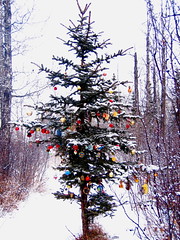
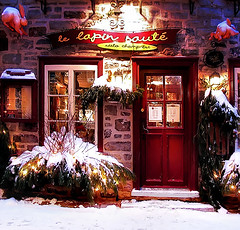
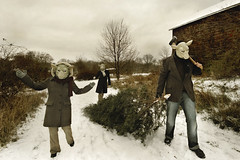
Since a picture is worth a 1000 words and I have no words to share just now, I thought I'd post some nice photos from the folks at Flickr.

If you click on the image you can see a larger view and read the photographer's comments. You can also (if you have the time) explore the links offered up by this person. It leads to words within worlds... and alot of beauty.

My love to you, and have a very Merry Christmas.

Patty


Proud Mary


proud mary
Originally uploaded by Elan Photography.

orphan tree


orphan tree
Originally uploaded by Veronika Lake.

Hospitality*


Hospitality*
Originally uploaded by imapix.

If a Tree Falls in the Forest and There's No One Around to Make A Buck Is It Still Christmas?


Caught in the Snow


Caught in the Snow
Originally uploaded by creativity+.

Tuesday, December 19, 2006

Words of Christmas and the Baby


Originally uploaded by abhayah~.

Becky and I celebrated our twentieth Christmas early this year because soon she’ll be off to other climes with someone else she now calls, “Baby.”

We three have given one another a rather surreal year. And while I’m not sure if “surreal” is the most appropriate word to use, we could certainly start there if we agree to throw in pain, rage, turmoil, fear, insanity, sailing on the water, learning about love and blessedness as well.

Nothing has been easy. Not even last night, though we knew that we were now arriving at our own version of “Peace on Earth.” Still, emotions were at such a pitch twice we had to stop and recompose, forcing Baby finally to ask, “Are we going to do this every year?” Those were just the words we needed. They broke crying off into bashful laughter.

Then this morning, I came across these words by Jeanette Winterson. She’s a poet and of course much better with her words than I. These particular ones are from her December comments and they seem to put the events of “we three’s trials and tribs” into a larger context of the Season. So I pass them on to you. Perhaps you’ll find something of yourself amidst her sentiments.

Jeanette Winterson: ….it doesn’t matter what God you worship, if any, what matters is how you approach the spiritual life – what TS Eliot called, ‘a condition of complete simplicity, costing not less than everything.’…

Some people find that any religious poem or piece of music or painting feels closed to them, but that is usually because the piece has become too overlaid with ideology, or stolen for some false purpose, or that we ourselves lack the courage or the patience to see though the wrapper… [But]… if Christmas is to have any meaning – and it should – let it be its own message, and not one of fake sentiment or religiosity. The birth of Jesus is about new life, new beginnings, new possibilities, and it happens not when everything is going well, or in a 5 star hotel, or when we’ve just won the lottery, but in there with the animal feed, in the stable, cold and dark and unprepared for. This is a no-frills moment. Anyone can be generous and easy when everything is perfect – but a new chance, for yourself or others, just doesn’t usually happen that way.

Change, when it comes, is often uncomfortable and not at all how we imagined it. The clichés and the sentiment aren’t present in the Christmas Story – we added all that later. An unmarried mother gives birth in a stable – try that now and the tabloids would be after you as unfit, the child would be taken into care and Joseph would be named and shamed – and given a DNA test.

It is an uncomfortable story, and one that is worth a close reading. The moment, when it happens, is never easy, and the miracle we say we long for brings as many problems as it solves, because it demands an entire re-configuration of who we are.

(... And if you still have a few moments to doodle round the blog, return to the photo I selected here. Click on it and view it large sized on the Flickr website. I love the little shed reflected in the red bulb. And the snow flurries coming down... lovely world is captured here. Enjoy!)


Sunday, December 17, 2006

When Your Heart Bursts


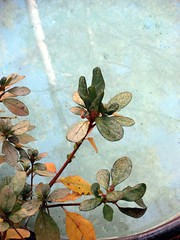
Azalea & Bath Paint
Originally uploaded by Seeking Tao.
I wanted a photo to illustrate some words of Adyashanti's that I came across today regarding the relationship between student and teacher. When I got to this particular part I burst into tears. Why? ...I think it was desire. So, here is what I read:

Adya: Most people come to satsang to hear what I have to say. I ought to give them popcorn and coke and send them off to the movies. It would be cheaper, and the seats are more comfortable.

Q: So why should we come here to satsang?

A: Because your heart wants to burst open, your mind wants to crack, and you are ready to die for freedom.


... probably you haven't had as strong a reaction as I did. But anyway, there it is.

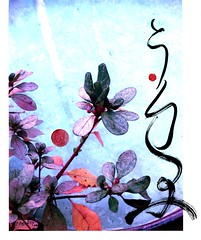
I went on with my day too. I "had" to work on my "paintings." One result, I'm posting this picture which is the photo I posted earlier today (see the next entry below this one) now transformed by what I put it through.

It's curious to me.

I printed the photo out on special paper and then did my chop and squiggle thing and then scanned it back into the computer. It looks diferent now. The picture has "gone through me." Both it and I were transformed a bit. The change is visible in the image. You'll have to take my word about myself, about a heart that wants to burst and a mind that needs to crack... and as for the dying... that happens on its own if you do the first two right.

Azalea & Bath


Azalea & Bath
Originally uploaded by Seeking Tao.


The silence inside of you
is the sound of your knowledge collasping.
Remember, it is you who said,
"I want to be free."

Adyashanti

We were getting ready for a birthday party when I decided to snap some photos of Pat's garden in the winter. This is one version of the results. Later, we would have a bonfire in that very same garden.

Monday, December 11, 2006

Twist Again

I went to a party this weekend and found myself a bit dismayed by a conversation a few of us had after our rousing game of charades. In the living room we sat around the fire as one woman tried to explain that she no longer knew what hope was. To her the world is peopled by deeply flawed humans, basically no different from the Middle Ages or the Dark Ages. Another woman spoke of her total distrust of government, yet another of how we now all carried deep seated anxiety. Yet, we all agreed that human beings have a remarkable capacity for goodness. This last point brought to life perfectly when I noticed that while we all talked doom and gloom, at the other end of the house they danced to “Twist Again, like you did last summer.” Tears came to my eyes. Such dear women, approaching and past 60-oh-my-god years old, could still dance in simple delight.

I gave no reply Saturday night. I simply listened. Today I’d like to offer these comments from Eckhart Tolle.

A question to Eckhart Tolle: Do you believe that humanity is ready for this transformation [into a “New Earth”]?

Tolle: Yes. I see signs that it is already happening. For the first time there is a large scale awakening on our planet. Why now? Because if there is no change in human consciousness now, we will destroy ourselves and perhaps the planet. The insanity of the collective egoic mind, amplified by science and technology, is rapidly taking our species to the brink of disaster. Evolve or die: that is our only choice now. Without considering the Eastern world, my estimate is that at this time about ten percent of people in North America are already awakening. That makes thirty million Americans alone, and in addition to those people in other North American countries, about ten percent of the population of Western European countries are also awakening. This is probably enough of a critical mass to bring about a new earth. So the transformation of consciousness is truly happening even though they won’t be reporting it on tonight’s news.

Is it happening fast enough? I am hopeful about humanity’s future, much more so now than when I wrote The Power of Now. In fact that is why I wrote that book. I really wasn’t sure that humanity was going to survive. Now I feel differently. I see many reasons to be hopeful.

Another Question….In your vision of a new earth, the purpose of life involves what you call awakened doing. What do you mean by this?

Tolle: …awakened doing has three modalities, depending on circumstances and the nature of the activity. They are acceptance, enjoyment, and enthusiasm. If there is neither acceptance, enjoyment, or enthusiasm in what you do, you are out of alignment with universal purpose. You are creating unhappiness, that is to say suffering in one form or another. One way of defining the ego is simply this: a dysfunctional relationship with the present moment. What I refer to as the “new earth”—the outer forms created by awakened doing—arises as more people realize that their purpose is to allow consciousness to emerge through whatever they do.

From An Interview with Eckhart Tolle
by Kathy Juline
Reprinted from the October 2006 issue of Science of Mind magazine and posted on the Eckhart Tolle website. Go there for more.

Sunday, December 10, 2006


Fair is Fair...

Soon, hopefully, you will be reading about Bennie.
However, I didn't use a picture of him when composing that entry... for shame.

This is Bennie. All Boy. Nine months old.

Friday, December 08, 2006

Dog's Rule


Charlie With Pine Cone
Originally uploaded by luckyrob.

Rule Number One (almost) in the training of a new puppy is that they shouldn’t growl at you as they eat their food. To my great dismay my pup, Bennie, broke this rule. In fact he was downright hostile when protecting a rib-bone. The solution that I found online having Googled “growling over food bowl” was to divide his dinner up into four identical servings which I presented to him in identical bowls. I'd put one bowl down, let him eat, then pick it up and give him the next. What Bennie was to learn through this exercise was that whenever I took one delight away it was to give him yet another. In time, Bennie trusted me and my intentions enough that I could feed him in a single bowl. If I came near while he was eating he wasn’t worried. He didn’t growl. Now, he even trusts me enough to come on his own accord and curl up against my belly while he chews his precious rawhide delights.

Now, why do I bother to mention all this? Because sooner or later Life and the Powers That Be will snatch out from under each of us that which we hold to be most precious in our life. Sooner or later, we all will know loss.

Maybe we will be lucky and the loss will fall within the realm of "the natural order of things." We expect to lose our parents. We don’t expect to lose a child. We expect to lose our partners… if they are older or no longer deserving. But, how much more painful if we are betrayed by infidelity or disease. We expect to lose our physical prowess… but only as we slowly age. We feel betrayed by the accidental and uncalled for-be it aberrant gene or the drunk driver that crosses the median headon into us.

But, have we really been betrayed, tricked, or forgotten by "On High?"

I don’t think so. Or at least no more so than Bennie when I whisk the bowl out from under his nose, or pry his jaws apart to remove a plastic bottle cap he's found. I have a bigger picture in my mind than little Bennie does. And by and large (though I do have my slip-ups) I act in his best interests whenever I take away his latest, greatest love.

I have to have the faith that Life/God - That all pervading Intelligence that plays and displays Creation- is at least as caring as I am for my dog. And if God doesn’t choose to guide my development by dividing my dinner into equal portions placed on identical plates … well, maybe He’s giving me credit for having a bit more brain to work with than Bennie has been blessed with.

And maybe, He’s simply encouraging me to develop the simple love and trust a little dog can have.

Tuesday, November 28, 2006

The Big Debate

There’s a big debate currently running in the journal Medical Hypotheses regarding whether or not meditating, specifically, Transcendental Meditation (TM), can cause epilepsy. I find this interesting for a number of reasons.

First, it is because in hind-site I recognize a number of the features of the spiritual emergency I went through following my abrupt awakening in 1975 to point to my having episodes of temporal lope epilepsy. I often fell to the floor in seizure-like rigidity (however I never lost consciousness), I would be gripped for hours by the desire to write (hypergraphia). I probably qualified as being hyperreligous. I recall also the day I found myself sitting on my bed with no idea as to how I came to be there or why. When I went downstairs I found a wastebasket sitting in the middle of the living room- oh yes, I was cleaning house. Apparently, I had had a complex partial seizure and had wandered upstairs. To this day, there are times when it feels as if my brain is snapping and popping with electricity. It’s a strange feeling and I don’t understand how one could really perceive such activity. But, I know what I feel and I know I don’t like it.

Secondly, there are the rationales of why meditation may have this effect. In TM EEG coherence and synchrony have been linked to a higher state of consciousness. However, neural hyper-synchrony is also a defining feature of epilepsy. It’s argued that TM could either provoke seizures in meditation or long term as the brain is “chronically kindled” with hyper-activity that develops into epilepsy outside of meditation. Physiologically, TM has been found to enhance glutamate, an excitatory neurotransmitter that an give rise to kindling even in normal brains. TM also increases serotonin, a neurotransmitter with both facilitating and inhibitory effects on seizure.

Finally, it is interesting to watch the scientists who do research on Transcendental Meditation (TM) and who are devoted followers of the TM path. They are not about to admit that TM can do any harm. Yet, they want to argue that the technique has a powerful influence upon the body. To my thinking, anything that can have a powerful influence can also cause an “abnormal” reaction. TM does not have to benefit everyone, every time to qualify as very valuable. But, early on Maharishi made this broad and uncritically examined claim, and so his followers maintain that stance today. That’s disappointing to say the least.

(Please click on the image to read about its commentary. I searched for photos tagged “debate.”)

The Sacred Disease.


Natraja_2
Originally uploaded by Chitrakari.

Epilepsy was known in ancient times as “the sacred disease.” In 1997, Savir and Rabin, two psychiatrists at UCLA, explained how temporal lobe epilepsy could help define a neural substrate for religious experience. Now, there are many papers on the subject.
But, I was fascinated to discover what a most ancient medical text, had to say about the disease.

The Ayurvedic Charaka Samhita (400 BC) is the oldest existing Indian medical text and is fascinating for many reasons. For example, there it’s description of how the thirst for understanding was inspired not by the problems of the general Indian populace, but rather due to the needs of the “meditators” of that time.

“When people, who lived their lives for spiritual pursuits and observed austerity, self-analysis, studies, chastity, meditation and other spiritual activities, began to have diseases and disorders that hindered in spiritual pursuits, at that times, the great sages gathered in the Himalayan region motivated by compassion for righteous persons….gathered at this first ancient ayurvedic symposium.”
Charaka Samhita, Sutra Section, Ch 1/v.6-12.


Perhaps because of this origin, the Charaka Samhita takes a somewhat different stance than Ayurvedic texts that came later. It describes Life as fundamentally a field of intelligence. This field is both self-aware and is pure knowledge: both the Knower and the object of perception. It was this most subtle level of life - that is Consciousness itself, which was to be treated by the physician.

The Charaka Samhita contains abundant references to all aspects of epilepsy including symptomatology, etiology, diagnosis and treatment. Epilepsy is described as ‘apasmara’ which means ‘loss of consciousness.’ In Hindu mythology Apasmara is also a dwarf who represents both ignorance (avidya) and epilepsy.

It is Apasmara-Purusha, the dwarf-demon, who is crushed and killed by the right foot of Shiva during His Cosmic dance of creation and destruction. Apasmara was causing lots of problems for people. Apasmara, highly ignorant and a trouble maker, is said to be a symbol of the laziness, dullness, and evil feelings within each of us. It is also said that the people prayed to Shiva to save them from the demon’s bad deeds. Shiva appeared in the world and killed him. It is Shiva Nâtarâja: the divine dancer whose movements creates and destroys worlds. These movements are illustrated as mudras, sacred hand and foot positions. Shiva holds a damaru or small two sided drum which punctuates the rhythm in one hand. In the other hand he holds a flame, the symbol of knowledge. Yet another hand is in the mudra abhava or “lack of fear.”

So now all these little bells are going off inside my head. At least 3000 years ago Ayurvedic medicine was meant to treat the problems of meditators’ progress. Today, there is this debate about one problem cropping up in meditators – epilepsy. Yes, people never meditating get the disease. But, now evidence is accumulating that perhaps the path to enlightenment may involve some increased danger of kindling and seizure. Meditation is so central to the path, as central (one might say) as this image of Shiva and his Cosmic dance is to mythology. And what is this epilepsy ? - a demon, the ignorance (avidya) of our own egos. … Ahh, if only I’d gotten around to writing up my thoughts about laish avidya- the “remains of ignorance” we each retain after enlightenment… then avidya would be ringing a little bell with you too. And finally, how curious a balance Shiva maintains in his dancing. He brings a two-sided drum. Go banging on the old Yin/Yang. It is rhythm, synchrony, coherence that is needed to defeat the demon. And that is just what the meditator’s and epileptic’s EEGs are all about.

Monday, November 06, 2006

Enlightenment: Before, During, and After


Smart But Casual
Originally uploaded by Kenny Maths.
The November/December 2006 issue of Spirituality and Health has an autobiographical essay by a woman entitled Enlightenment: Before, During, and After. In it she describes how through Awareness Intensive retreats where the practice consists of considering “Who am I?” hour after hour. Through the practice she felt she became enlightened. She was filled with joy and peace, could generate an energy that filled the room and had the power to transform the consciousness of others. Students came in greater and greater numbers and she held satsangs. Then she cracked and crashed and burned. The initial blow was the death of her teaching companion, but that was only the first step down. Her original guru was unable to help. She found a new master. He told her to stop teaching. Afraid she needed the money she refused to stop teaching, only to have her students desert her. And her descent continued from there until she was reduced to friends and family supporting her, and then her second teacher went into seclusion- essentially abandoning her. Throughout her story she comments upon the nagging little thoughts like- “Now I never have to worry about money… I have what everyone wants.” “Now I never have to bother with sex and relating…I am beyond all that.” And she noticed how her ego swelled in direct proportion to her students’ adulation and her power to radiate energy. And while not her closing words, this was her greatest lesson to me:

“If we do not have a living teacher at the time of awakening, we are in great trouble. We simply cannot travel alone at this point, precisely because we can hardly see the ego by ourselves.”

This story suddenly put into context some comments of Eckhart Tolle that caught my eye months ago. They’re from an interview by John W. Parker and are excerpted from Dialogues With Emerging Spiritual Teachers.

Parker: Is it possible to be perfectly enlightened and have any remains of an ego?

Tolle: Well, perhaps not perfectly enlightened, but there can be remains of ego still there, because I have seen it in teachers. I have seen the ego return in some teachers.

So the ego can go into almost a "coma," and then wake up out of its coma perhaps due to the projections, ego-projections that the teacher is bombarded with. As the teacher is there, more people appear and gather around the teacher. And they (those who gather around them) all have their own ego-projections. They make the teacher very "special." And special-ness is always ego, whether special in my misery or special because I am the greatest, the ego doesn't really mind. So perhaps in those teachers the ego was not completely gone. It just had been reduced to an extremely weak state, but then gained strength again.

This was a surprise to me, and very interesting. Given my own experience of “I saw God and all Hell broke loose,” and being trained in chemistry, I’d always pictured getting there and then losing it something like Sisyphus pushing his boulder almost to the top of the hill (so he got a glimpse from the top), but then he lost it and the rock rolled back down. He never actually made it over the top and down into paradise. Such a hill, or technically an energy barrier, must be overcome in every single chemical reaction. Two reactants may come together temporarily, bind into an “activated state.” Then they either they fall back to their original state and dissociate, or they make it over to the other side and are permanently altered. Thus, oxygen and hydrogen can either transmute into water or fall back into two separate gases.

Similarly, I thought my body-mind simply couldn’t make it over that energy barrier. I couldn’t maintain that integrated state and hold onto that enlightened vision. I figured my body let me down. But Tolle suggests that the ego, temporarily knocked cold turkey, regains it strength and returns to it’s old tricks of identification. Ego – not so much as physiology appears to be the problem here. And I had tried so hard to rebuild my adrenals, restore depleted minerals and fatty acids, to stop the anxiety and panic attacks, to stop my brain from “crackling” with jolts of electricity.

These were necessary actions at the time. But, was I addressing the deepest roots of my problem? Or are there layers of traps here: body, mind, and ultimately ego?

Then I came across these words of Adyashanti:

After sudden Awakening to the Self, there begins a process of gradual embodiment of the transcendent into the human personality. By gradual I mean the deepening of realization after the experience of enlightenment…This process of embodiment is a continual stripping away of every remnant of attachment and ego…It is a phase of spiritual unfolding fraught with many dangers, self-deceptions, and misunderstandings. It is where many seekers of liberation succumb to fear, doubt , and a lack of conviction…It is an area of incredible subtlety and complexity which few truly understand.

Adyashanti’s warnings seem to hark back directly to Tolle’s words and the woman whose ego re-awoke. This to me seems an “immaterial” realm of psyche rather than substance- be that fatty acids or B vitamins or even crackling electricity for that matter. But, then Adya made further comments:

Embodiment starts with the realization that every manifest thing and non-thing constitutes your true body. You humanness is simply a reflection of the depth of your realization… What’s most important is to perceive your entire body, which is everything… The entire cosmos is your body. Let your humanness reflect and manifest the whole.

This comment brought to mind my own awakening in 1975. After the initial shift in consciousness there was an interior “burning” (which I’ve described elsewhere). This burning seemed to be a purification/transmutation of my flesh and nervous system through the elements: earth to water to air to ether to finally the perception that my body (on one level and Ultimately) was Absolute, totally immaterial, and extended throughout the universe. At the time, content to simply Be, I was barely able to walk or talk or think and it was arranged for me to go stay with my brother for awhile. He took one look at me and pulled out a yellow legal pad. Starting at 9 a.m. he made a “To Do” schedule for me blocked out in 15 minute increments. Things like: load the dirty clothes into the laundry bag. Go to the laundry. Wash the clothes. Come home…

Very human, but not so well embodied I would say. On the other hand, I seemed to have taken the process pretty far and still managed in the end to fall back into an egoic, attached state.

So let me just end with these final comments by Adya:

As the opening [dissolving of the self] begins and deepens, the body may go through a tremendous amount…some people’s bodies experience a real shake-down. This can be quite dramatic because energy that has been trapped on the various levels- physical, mental, emotional, and spiritual- is released. This trapped energy is what keeps you off-balance and in a state of suffering. Suddenly all the tension, holding, and knots are released, and the energy goes out in all directions.

This energy has to break loose before it can re-harmonize and get into the proper flow. This bursting can feel exhilarating or terrible… the harmonization may take weeks, months, or years. It may be very strong or imperceptible. Everyone is different; it just depends on how out-of-wack you’ve been.

Sunday, October 29, 2006

Spiritual Emergence


Mid-Afternoon Elegance
Originally uploaded by
jcowboy.

“The door to God is the insecurity of not knowing anything.
Bear the grace of that insecurity, and all wisdom will be yours.”
Adyashanti

For “She Who Fell into the River and was Swept into the Ocean”-

I said she fell into the “Wu” just to have a name for what had befallen her: this state of extreme Yin and openness that made her drop obligations and ultimately her job. She said she no longer wanted to think too much. She could not resist the pull of the river. And as the months passed the river became an Ocean, an Ocean she recognized as love. To her friends if felt like she was “going to leave town” or “move away.” Yet she had no plans to do so. She had few if any plans- except to buy a boat and learn to really sail. What an embodying of metaphor! Now, she says, she doesn’t know a thing. But, she has found a partner of utter solidity, someone to keep some ground under her. And recently she sailed that new boat of hers at over 5 knots, approaching the limits of hull speed.

This seems a gentle version of an enlightenment experience. One that wasn’t fought that much. To a large extent thinking was given up. Fears were faced and not allowed to impede the flow. And so process could proceed in a relatively gentle manner.

Adyashanti has some teachings that seem to relate to this experience:

At the moment of enlightenment everything falls away- everything. Suddenly the ground beneath you is gone, and you are alone. You are alone because you have realized that there is no other; there is no separation. There is only you, only Self, only limitless Emptiness, pure Consciousness.

To the mind, the ego, this appears terrifying. When it looks at limitlessness and infinity, it sees meaninglessness and despair. However, the view changes to unending joy and wonder once the mind is let go of.

What it takes


Transitions: Sun Set
Originally uploaded by LynchburgVirginia.
“She Who Fell into the River” went with the flow, which is not to say that it was easy or is easy.

Adyashanti sets out the dynamics this way:

Many people really see themselves as “the one who has struggled”… Others struggle to hold onto a more positive, fixed identity as a good, successful, or spiritual person. However, most people cling to both negative and positive self-images… [T]he reason that you struggle is in order to maintain a sense of separate self, a self which is ultimately a defense mechanism against the revelation that no separate self actually exists. As soon as you stop struggling, you lose the boundaries…with nothing to oppose, the false sense of self evaporates into nothingness, into the Unknown… Your identity is cut loose from all that is familiar and known and you find yourself floating in a vast expanse with nothing to grab hold of. This groundless expanse is the foretaste of liberation, but few choose to remain in this unknown territory…

Faced with a freedom that is absolute, a freedom that leaves no room for separation from the whole, most people will compulsively contract back into a condition of struggle where they can maintain a familiar sense of self. …

It is only when you desire to be free more than you desire the security of the familiar sense of self that you spontaneously move into a freedom that is final and beyond struggle….

This is not the liberation that most people envision when they start out… most people envision a freedom that they can attain and possess. So many who glimpse the enlightened condition tell me that is so much bigger than they ever could have imagined. [When you] realize that freedom [it] is not something that you possess, but something that possess you…

To have a glimpse of this profound freedom requires very little, but to live it requires the destruction of every concept of self you ever held or will ever hold. This freedom is a flame that burns the need to struggle to ash and reveals one’s Self to be all that is.

Wednesday, October 18, 2006

For Chris and Olga


Beauty of the Moon
Originally uploaded by MacroFocus.

Olga passed last night, the mother of my dear friend, Chris. Olga had two daughters and each was by her side as she lay at peace. Olga was Ukrainian. Her husband (also from the Ukraine) preceded her in death by thirty years, almost to the day. So with a bow to these dear women and all that lived between them, I offer these notes... not speaking of them directly- but rather the poet laureates Jane Kenyon and Donald Hall. Why these two? Because they're poets and they lived and loved and poetry speaks better than mere words at a time like this.


Twilight: After Haying
by Jane Kenyon

Yes, long shadows go out
from the bales; and yes, the soul
must part from the body:
what else could it do?

The men sprawl near the baler,
too tired to leave the field.
They talk and smoke,
and the tips of their cigarettes
blaze like small roses
in the night air. (It arrived
and settled among them
before they were aware.)

The moon comes
to count the bales,
and the dispossessed--
Whip-poor-will, Whip-poor-will
--sings from the dusty stubble.

These things happen. . .the soul's bliss
and suffering are bound together
like the grasses. . .

The last, sweet exhalations
of timothy and vetch
go out with the song of the bird;
the ravaged field
grows wet with dew.

Finding A Long Gray Hair
by Jane Kenyon

I scrub the long floorboards
in the kitchen, repeating
the motions of other women
who have lived in this house.
And when I find a long gray hair
floating in the pail,
I feel my life added to theirs.


Jane Kenyon was an American poet and translator. She was born in 1947 in Ann Arbor, Michigan, and grew up in the midwest. While a student at the University of Michigan, Kenyon met the poet Donald Hall; though he was some twenty years her senior, she married him in 1972, and they moved to Eagle Pond Farm, his ancestral home in New Hampshire. Kenyon was New Hampshire's poet laureate when she died in April of 1995 from leukemia. Hall currently is the US Poet Laureate. Without: Poems was published on the third anniversary of Jane Kenyon's death. Most of the poems in Without deal with Kenyon's illness and death, and many are epistolary.

Tuesday, October 17, 2006

It’s as simple as this:


Deep thoughts ... {}
Originally uploaded by dotlyc.
Student: I am confused because I see the Silence outside me. It is an Ocean I walk through and it’s not within me. My expectation is that it should be inside me and radiate out.
Teacher: And what happens if you attend to the Silence?
Student: It becomes more intense, the Silence and the Gap become absurd, and laughter begins. There is this incredible laughter.
Teacher: And who is laughing?
Student: I am laughing deep inside. And the Universe is laughing.
Teacher: And?
Student: And it is the same laughter … There is only one person laughing. The Universe and I are one.
(and now in tears, the student gets it. I just hadn’t ever noticed)