This morning I was listening to John Kabat-Zinn being interviewed on Speaking of Faith. He was giving an articulate argument for mindfulness but my curiosity was peaked when he was asked to address the fact that his father had been a scientist and his mother an artist.
These are my roots too.
The mixing of these two opposites play out in my life each day.
Kabat-Zinn was asked to explain.
He declined a “cognitive” reply and chose instead a poem saying, "it's not very long, but it really hinges around just this issue of who we are and how much we split ourselves apart."
Love After Love
The time will come
when, with elation
you will greet yourself arriving
at your own door, in your own mirror
and each will smile at the other's welcome,
and say, sit here. Eat.
You will love again the stranger who was your self.
Give wine. Give bread. Give back your heart
to itself, to the stranger who has loved you
all your life, whom you ignored
for another, who knows you by heart.
Take down the love letters from the bookshelf,
the photographs, the desperate notes,
peel your own image from the mirror.
Sit. Feast on your life.
Derek Walcott
Showing posts with label Speaking of faith. Show all posts
Showing posts with label Speaking of faith. Show all posts
Sunday, April 19, 2009


Sunday, November 30, 2008
Stories
This morning as I did my asanas I listened to Rachel Naomi Remen being interviewed on Speaking of Faith. The program closed with this story.
The most important questions don't seem to have ready answers, but the questions themselves have healing power when they are shared. An answer is an invitation to stop thinking about something, to stop wondering. Life has no such stopping places, life is a process whose every event is connected to the moment that just went by. An unanswered question is a fine traveling companion. It sharpens your eye for the road.
In some fairytales, there is a magic word which has the power to undo the spell that has imprisoned someone and free them. When I was small, I would wait anxiously until the prince or the princess stumbled on the formula and said the healing words that would release them into life. Usually the words were some sort of nonsense like "Shazam." My magic words have turned out to be "I don't know."
Rachel Naomi Remen, Kitchen Table Wisdom: Stories That Heal
I’ve posted here some teachings regarding stories. Byron Katie is huge on how they hide us from the Truth about ourselves. We tell ourselves stories and make the situation worse. She encourages us to look closely at what we say and ask, “Is that true?” Usually, we must reply, “I don’t know.”
Well, Rachel Naomi Remen takes just about the exact opposite approach. But, it doesn’t mean she comes out in so very different a place.
Here is a story regarding tikkun olam, “restoration of the world.” I have also posted about tikkun before.
In the beginning there was only the holy darkness, the Ein Sof, the source of life. And then, in the course of history, at a moment in time, this world, the world of a thousand thousand things, emerged from the heart of the holy darkness as a great ray of light. And then, perhaps because this is a Jewish story, there was an accident, and the vessels containing the light of the world, the wholeness of the world, broke. And the wholeness of the world, the light of the world was scattered into a thousand thousand fragments of light, and they fell into all events and all people, where they remain deeply hidden until this very day.
Now, according to my grandfather, the whole human race is a response to this accident. We are here because we are born with the capacity to find the hidden light in all events and all people, to lift it up and make it visible once again and thereby to restore the innate wholeness of the world. It's a very important story for our times. And this task is called tikkun olam in Hebrew. It's the restoration of the world.
It's a very old story, comes from the 14th century, and it's a different way of looking at our power. And I suspect it has a key for us in our present situation, a very important key. I'm not a person who is a political person in the usual sense of that word, but I think that we all feel that we're not enough to make a difference, that we need to be more somehow, either wealthier or more educated or somehow or other different than the people we are. And according to this story, we are exactly what's needed. And to just wonder about that a little, what if we were exactly what's needed? What then? How would I live if I was exactly what's needed to heal the world?
You can find the complete transcript of the interview with Dr. Remen here. It’s good.
The most important questions don't seem to have ready answers, but the questions themselves have healing power when they are shared. An answer is an invitation to stop thinking about something, to stop wondering. Life has no such stopping places, life is a process whose every event is connected to the moment that just went by. An unanswered question is a fine traveling companion. It sharpens your eye for the road.
In some fairytales, there is a magic word which has the power to undo the spell that has imprisoned someone and free them. When I was small, I would wait anxiously until the prince or the princess stumbled on the formula and said the healing words that would release them into life. Usually the words were some sort of nonsense like "Shazam." My magic words have turned out to be "I don't know."
Rachel Naomi Remen, Kitchen Table Wisdom: Stories That Heal
I’ve posted here some teachings regarding stories. Byron Katie is huge on how they hide us from the Truth about ourselves. We tell ourselves stories and make the situation worse. She encourages us to look closely at what we say and ask, “Is that true?” Usually, we must reply, “I don’t know.”
Well, Rachel Naomi Remen takes just about the exact opposite approach. But, it doesn’t mean she comes out in so very different a place.
Here is a story regarding tikkun olam, “restoration of the world.” I have also posted about tikkun before.
In the beginning there was only the holy darkness, the Ein Sof, the source of life. And then, in the course of history, at a moment in time, this world, the world of a thousand thousand things, emerged from the heart of the holy darkness as a great ray of light. And then, perhaps because this is a Jewish story, there was an accident, and the vessels containing the light of the world, the wholeness of the world, broke. And the wholeness of the world, the light of the world was scattered into a thousand thousand fragments of light, and they fell into all events and all people, where they remain deeply hidden until this very day.
Now, according to my grandfather, the whole human race is a response to this accident. We are here because we are born with the capacity to find the hidden light in all events and all people, to lift it up and make it visible once again and thereby to restore the innate wholeness of the world. It's a very important story for our times. And this task is called tikkun olam in Hebrew. It's the restoration of the world.
It's a very old story, comes from the 14th century, and it's a different way of looking at our power. And I suspect it has a key for us in our present situation, a very important key. I'm not a person who is a political person in the usual sense of that word, but I think that we all feel that we're not enough to make a difference, that we need to be more somehow, either wealthier or more educated or somehow or other different than the people we are. And according to this story, we are exactly what's needed. And to just wonder about that a little, what if we were exactly what's needed? What then? How would I live if I was exactly what's needed to heal the world?
You can find the complete transcript of the interview with Dr. Remen here. It’s good.
Thursday, September 04, 2008
Fishing with Mystery
at some point in my life, fishing was a way of achieving a timelessness, especially fishing in rivers because rivers have a very timeless quality.
They're always flowing, flowing, flowing.
They're flowing down to the sea.
The clouds form, they float over the countryside, the rain falls, they fill up the ground, the springs…
The stream is kind of this immortal entity, at least in my mind…
and you kind of get swept up in this immortal cycle and kind of lose yourself.
Naming gives us the illusion that nature is fixed, but it is as fluid as the language used to describe it.
It is a challenge of the artist (if no one else) to un-name and re-name the world to remind us that fresh perspectives exist.
James Prosek
On Speaking of Faith last Sunday Krista Tippett interviewed artist, trout fisherman, and something of a mystic, James Prosek. I loved the show.
I’ve written before about the limitations of naming.
Prosek probably shares this critcism, but he arrives there from such a different path it’s well worth walking with him for awhile:
When I was four or five years old, I would draw birds at the kitchen table.
As I finished each piece I asked my mother to write the names of the birds beneath the pictures…Somehow a picture wasn’t finished if the animal’s name wasn’t there.
When I learned to write, I scrawled the common and scientific names of each creature beneath my drawings myself— by example of Audubon, or any others who made paintings in the natural-history tradition.
At nine I developed a passion for trout and began to compile a list of all the diverse types…
As I painted trout through my late teens, major shifts in trout taxonomy were taking place… I began to understand that species were less static than the fathers of modern taxonomy… once believed.
That nature was static and classifiable was an idea perpetuated by the natural history museum (repository for dead nature), the zoo (repository for living nature), and the book (repository for thoughts and images related to nature).
These mediums were all distillations of nature, what individuals of authority deemed an appropriate cross section to present to the public.
None had adequately represented Nature—at once chaotic, multifarious, and interconnected…
I was conflicted—I loved the names that had first led me to recognize the existence of diversity… but as I learned more I wanted to throw away the names, step beyond those constraints, in order to preserve a sense of wonder that I had felt from an early age.
Such thoughts were the origin of the curvilinear lines in my present work….
The first paintings I did with lines emanating from creatures were meant to be imaginings of what God’s or Nature’s blueprint of a particular creature might look like. … The lines activated the space around the animal in a satisfactory way, erasing the need for the name to be written beneath….
James Prosek, The Failure of Names
Such lines also bring to mind the Australian aboriginal Songlines.
During the Dreamtime, archetypal ancestral spirits are said to have wandered across the Earth creating and naming trees, rocks, waterholes, animals and other natural phenomena.
Their dreaming and journeying trails became the songlines, an intricate series of song cycles that identify landmarks and serve as subtle tracks for navigation.
To me, Songlines seem an earthly version of the energy channels and flowing Qi that one becomes aware of through meditation and an illustration of the Taoist emphasis of the connection between macrocosm and microcosm.
That Prosek seems to have discovered similar lines and meanings really delights me.
Click Here, if you’d like to see a “The Myth of Order,” a video of Prosek’s art accompanied by his own narration.
It’s well worth the three minutes –just be patience for Krista Tippett’s face to disappear.
Or, Click Here to see a tattooed Buddha – another artist’s vision of the energy channels?
They're always flowing, flowing, flowing.
They're flowing down to the sea.
The clouds form, they float over the countryside, the rain falls, they fill up the ground, the springs…
The stream is kind of this immortal entity, at least in my mind…
and you kind of get swept up in this immortal cycle and kind of lose yourself.
Naming gives us the illusion that nature is fixed, but it is as fluid as the language used to describe it.
It is a challenge of the artist (if no one else) to un-name and re-name the world to remind us that fresh perspectives exist.
James Prosek
On Speaking of Faith last Sunday Krista Tippett interviewed artist, trout fisherman, and something of a mystic, James Prosek. I loved the show.
I’ve written before about the limitations of naming.
Prosek probably shares this critcism, but he arrives there from such a different path it’s well worth walking with him for awhile:
When I was four or five years old, I would draw birds at the kitchen table.
As I finished each piece I asked my mother to write the names of the birds beneath the pictures…Somehow a picture wasn’t finished if the animal’s name wasn’t there.
When I learned to write, I scrawled the common and scientific names of each creature beneath my drawings myself— by example of Audubon, or any others who made paintings in the natural-history tradition.
At nine I developed a passion for trout and began to compile a list of all the diverse types…
As I painted trout through my late teens, major shifts in trout taxonomy were taking place… I began to understand that species were less static than the fathers of modern taxonomy… once believed.
That nature was static and classifiable was an idea perpetuated by the natural history museum (repository for dead nature), the zoo (repository for living nature), and the book (repository for thoughts and images related to nature).
These mediums were all distillations of nature, what individuals of authority deemed an appropriate cross section to present to the public.
None had adequately represented Nature—at once chaotic, multifarious, and interconnected…
I was conflicted—I loved the names that had first led me to recognize the existence of diversity… but as I learned more I wanted to throw away the names, step beyond those constraints, in order to preserve a sense of wonder that I had felt from an early age.
Such thoughts were the origin of the curvilinear lines in my present work….
The first paintings I did with lines emanating from creatures were meant to be imaginings of what God’s or Nature’s blueprint of a particular creature might look like. … The lines activated the space around the animal in a satisfactory way, erasing the need for the name to be written beneath….
James Prosek, The Failure of Names
Such lines also bring to mind the Australian aboriginal Songlines.
During the Dreamtime, archetypal ancestral spirits are said to have wandered across the Earth creating and naming trees, rocks, waterholes, animals and other natural phenomena.
Their dreaming and journeying trails became the songlines, an intricate series of song cycles that identify landmarks and serve as subtle tracks for navigation.
To me, Songlines seem an earthly version of the energy channels and flowing Qi that one becomes aware of through meditation and an illustration of the Taoist emphasis of the connection between macrocosm and microcosm.
That Prosek seems to have discovered similar lines and meanings really delights me.
Click Here, if you’d like to see a “The Myth of Order,” a video of Prosek’s art accompanied by his own narration.
It’s well worth the three minutes –just be patience for Krista Tippett’s face to disappear.
Or, Click Here to see a tattooed Buddha – another artist’s vision of the energy channels?
Wednesday, December 26, 2007
Christmas with Jean Vanier
My Sunday morning routine of asanas accompanied by classical music changed when our local Public Broadcasting radio station changed its schedule.
Now, rather than music, I am more likely to be listening to Christa Tippett’s program, “Speaking of Faith.” That’s OK. After all, it is Sunday.
The Sunday before Christmas brought up what I thought was a “repeat.” I’d already heard one show on Jean Vanier and the L’Arche community. So, there was a bit of internal grumbling as I stretched into the next asana.
But if this was a repetition, I hadn’t really listened before.
Or more likely, I wasn’t ready to hear before.
But, I stopped my yoga mid-posture when I heard these word:
You see, the big thing for me is to love reality and not live in the imagination, not live in what could have been or what should have been or what can be, and somewhere, to love reality and then discover that God is present.
Jean Vanier
Oh!
I would like to do this too.
And I would like to share some snippets of transcript (edited a bit for a smoother read) as my belated Christmas message.
MS. TIPPETT: … in 1963, Jean Vanier was a professor of philosophy at St. Michael's College in Toronto. At Christmas time that year, he went to visit a friend in France who was working as a chaplain for men with mental handicaps. Vanier found himself drawn to these human beings shut away from society. He was especially moved by a vast asylum south of Paris in which all day, 80 adult men did nothing but walk around in circles and take a two-hour compulsory nap. He bought a small house nearby and invited two men from that asylum to share life with him…
MR. VANIER: …I come back to the reality of pleasure and to the reality of what is my deepest desire and what is your deepest desire.
And … the deepest desire for us all is to be appreciated, to be loved, to be seen as somebody of value.
But not just seen —
Aristotle makes a difference between being admired and being loved. When you admire people, you put them on pedestals. When you love people, you want to be together.
So really, the first meeting I had with people with disabilities, what touched me was their cry for relationship.
Some of them had been in a psychiatric hospital.
All of them had lived pain and the pain of rejection.
One of the words of Jesus to Peter — and you find this at the end of the gospel of Saint John — "Do you love me?"
MS. TIPPETT: All kinds of pain and weakness are difficult for us as human beings. Why is that so excruciating? Why do we do such a bad job with it?
MR. VANIER: … First of all, we don't know what to do with our own pain, so what to do with the pain of others?
We don't know what to do with our own weakness except hide it or pretend it doesn't exist.
So how can we welcome fully the weakness of another if we haven't welcomed our own weakness?
There are very strong words of Martin Luther King. His question was always, how is it that one group — the white group — can despise another group, which is the black group? And will it always be like this? Will we always be having an elite condemning or pushing down others that they consider not worthy?
And he says something, which is quite, what I find extremely beautiful and strong…
we will continue to despise people until we have recognized, loved, and accepted what is despicable in ourselves.
So then we go down, what is it that is despicable in ourselves?
And there are some elements despicable in ourselves, which we don't want to look at,
but which are part of our natures, that we are mortal… [and too]
We are very fragile in front of the future.
Accidents and sicknesses is the reality.
We are born in extreme weakness and our life will end in extreme weakness.
So this, people don't want to hold on to that.
They want to prove something. They want security. They want to have big bank accounts and all that sort of stuff.
So then also, a whole lots of fear is within us.
MS. TIPPETT: I know you've written that, from the point of view of faith, those who are marginalized and considered failures can restore balance to our world. …
MR. VANIER: The balance of our world frequently is seen as a question of power.
That if I have more power and more knowledge, more capacity, then I can do more.
…and when you have power, we can very quickly push people down.
I'm the one that knows and you don't know,
and I'm strong and I'm powerful, I have the knowledge.
And this is the history of humanity.
"As we share our lives with the powerless, we are obliged to leave behind our theories about the world, our dreams and our beautiful thoughts about God, to become grounded in a reality that can be quite harsh." Jean Vanier
MS. TIPPETT: …So I asked Jean Vanier how does he think about the nature of God and of Jesus as he approaches his 80s.
MR. VANIER: My experience today is much more the discovery of how vulnerable God is.
You see, God is so respectful of our freedom.
And if, as the Epistle of John says, God is love, anyone who has loved in their life knows they've become vulnerable.
Where are you and the other person and do you love me back?
So if God is love, it means that God is terribly vulnerable.
And [too] God doesn't want to enter into a relationship where He's obliging or She is obliging us to do something.
The beautiful text in the Apocalypse, the Book of Revelations: "I stand at the door and I knock. If somebody hears me and opens the door, then I will enter."
What touches me there is God knocking at the door, not kicking the door down, but waiting.
Do you, will you open?
Do you hear me?
Because we're in a world where there's so much going on in our heads and our hearts and anxiety and projects that we don't hear God knocking at the door of our hearts.
So I'd say that what touches me the deepest, maybe because I'm becoming myself more vulnerable, is the discovery of the vulnerability of God, who doesn't oblige.
MS. TIPPETT: And, of course, one implication of the vulnerable God, of honor in human freedom is precisely this dark side that we've been talking about,
that human beings cause each other pain, dominate, and destroy.
And so, I'm kind of coming back at you with the question of still, if God is God, is that enough to honor our freedom?
MR. VANIER: …there are so many things we don't know.
And, I just have to honor what I don't know.
— there are so many things I cannot explain, because explanation is something about headiness.
You won't have it in the head.
But the whole question is not to understand,
it's to be attracted to the place of pain in order to give support to those who are suffering. … if we try to know too much, it might cut us away from being present.
It's a very moving thing with St. Francis of Assisi.
St. Francis said he couldn't stand lepers.
And one can understand a disfigured leper with no nose or no ear or parts of gaping, you know?
And in the Middle Ages …20,000 leprosiums, filled with these people that smelt bad and he said, "I hated it. I couldn't stand it."
And then he said that one day, the Lord brought me into the lepers.
“And when I left, there was a new gentleness in my body and in my spirit.”
This was, what struck me, when he said, “a new gentleness in my body and in my spirit.” And it says, “From there, I really left to serve to Lord.” …
from the fear and despisal of what appeared the most dirty…
he discovered there was a presence of God.
*****************************************************
Full program information on “The Wisdom of Tenderness” can be found here.
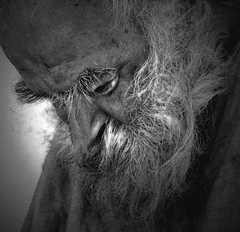
And PS – I had a hard time choosing a picture for this entry.
I wanted to post something uplifting, joyful, something that went with the Season.
I didn’t want a leper.
Subscribe to:
Posts (Atom)

