Monday, May 12, 2008

Grief: "Yes!"


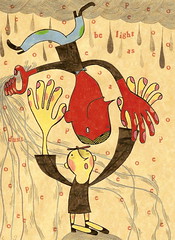
Canvas C
Originally uploaded by Seeking Tao

I’ve not written in a while – it has seemed impossible.
I’ve decided to try posting snippets, and in this case, a transcript that I’ve been contemplating.

It’s a rather long excerpt from an Adyashanti CD, Enlightenment: The Direct Approach.
It deals with grief: grief with a capital G - grief that at times shakes the student, Adya is talking with, into convulsions.
Such deep grief has become very familiar to me in the past few months.

I want to understand such grief.
But, also notice that when Adya speaks of resisting the Immensity he speak of the entire Cosmos and he doesn’t frame his comments as metaphor or analogy. (He uses metaphor later, referring to plugging a hose with your thumb.)

The Grief at issue here touches an Immensity, and that Immensity apparantly involves, both experientially and in parsing Adya’s words, the entire Universe.
I was always embarrassed by Maharishi using the term Cosmic Consciousness.
Now, I believe he was simply trying to be accurate in his terminology.

How is this possible – that human consciousness becomes Cosmic?
What would that process feel like?
The proverbial camel and the eye of a needle come to mind.
But the extremes of the actual task are far greater actually: one individual and the entire Universe.

Notice too, that when Adya asks the student to explain her grief, she says she feels like she’s been “living life backwards.”
Awhile ago I mentioned Thomas Merton’s description of Adam’s sin as “a double movement of introversion and extraversion.”
In this phrase “living life backwards” we again meet something of that trick of twist.
Somehow, the Cosmos in which I exist seems to keep getting turned around and swallowed so that it resides within me.
I find this flip and twist excruitating. I react as one would to an electrocution.
Later, upon reflection, I find that returning to my true nature feels like executing some sort of fancy dive: forward somersault with full twist.
And you must pull it off without the slightest splash.

...But, the main point here regards grief and the transcript goes like this:

Student: About three months ago I gave up what I was doing, not really knowing why, but I just had to do it… I have this sense that there is something deeper in me wanting to move through and by doing what I was doing, I was just kind of bailing-out. And I just couldn’t do it anymore. But it really meant just falling back and giving up income and having no idea what was going to happen.

So what’s been happening in that process is just a lot of grief, just intense grief touching upon a depth of aloneness that is terrifying. I can intellectualize what is going on and yet … the feelings that come up are just so big, they feel like they are just going to rip me apart. And there is part of me that wants that, just let it take me over and I can’t…

Adya: It’s going to happen you know that. The moment is going to come and you’re not going to be able to resist it… It’s just about saying yes to it. Yes…. Whatever. Yes. It’s going to kill me. Yes. I’m ready.

Student: Yeah. I can say that when I’m not in it.

Adya: What I am saying is it will visit you until you get to that place where you really say/feel throughout your being, Yes.
Yes, you’re just done resisting…
There is a great Immensity that is coming up within you. The thing that makes it feel intense though, as opposed to immense (immense and intense are different things)… The Cosmos is immense. It’s not necessarily intense. The resistance of that much space, the resistance makes it be perceived as an intensity… Something holds on as the Immensity of Being is coming into your consciousness. Then It is experienced as very intense, overwhelming, terrifying maybe.
That’s why I say when you can get to the moment when you can just say, “Yes!” it’s like you’ve taken your finger off the front of the hose… It’s experienced totally differently. All is well. Then all is unimaginably well.

Student: Yeah. I’ve had glimpses of that… And you know the grief that is in there, that endless, endless grief, it just takes me over sometimes. It’s just unstoppable.

Adya: What’s the grief about? What’s the bottom of the grief?

Student: There’s really not a story or a memory…the best I can put it, I feel like I’ve been living life backwards in a way and that I’ve come to this core of I can call it separation, just the deepest, deepest core separation, just being ripped apart out of wholeness…I find it difficult because I don’t see it around me much. It feels like such a lonely process.

Adya: It feels lonely for the moment inside yourself [as other people hide it]… inside of us, [there] is the central wound…the core wound of turning away from what we really are. As soon as we turned away we experienced separation that causes a grief and suffering and everything else that follows. But as you get very close to that essential turning away… that’s the grief, the grief for having turned away from what you really were and the separation immediately issued. … it’s the grief of turning away from the immensity of what you really are.

Student: And that’s what it feels like, that I am on that edge. I just have to remember. I have to know what I hold in me, what I’m here to express, cause it’s just so painful not to.

Adya: You’ll find it by turning into that intensity. And when I say, “Yes,” I’m trying to impart a certain sense - it’s the letting go of resistance.

“The drop experiences the Ocean by becoming one with it.”
That’s what Maharishi use to say.
No complicated somersaults and twists need be involved.
In fact, Maharishi used to describe the inward dive of meditation as simply leaning over and letting go.

“Yes.”

Wednesday, April 30, 2008

Too Much Kissing


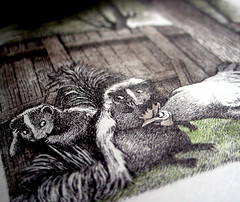
Too Much Kissing - Caught
Originally uploaded by Seeking Tao

When Little Bear’s Grandmother received the drawing he had made for her, she asked Hen to please give him a kiss from her. Hen said she would deliver the kiss, but when she ran into Frog, she passed the kiss to him asking, “Would you give this kiss to Little Bear?”

Frog agreed. But when he wanted to go swimming he passed the kiss on to Cat.
Cat agreed to deliver said kiss, but when he wanted to take a nap, he passed the kiss on to Skunk.
Skunk then saw this pretty little skunk and he gave the kiss to her.
She immediately gave it right back to him.
Skunk was in the process of giving the kiss yet again to the pretty little skunk, when Hen arrived upon the scene and declared,
“Too much kissing.”

I have always read this with an exclamation point,
though there is actually none in the text of this 1968 classic, A Kiss for Little Bear.

In the end, Hen delivered the kiss per the original plan.
Little Bear was happy. Grandmother was happy. Hen was relieved.
And the two little skunks got married which is the antecedent of course to, “happily ever after.”

Now, Why I am telling you this?

Turns out, “Too Much Kissing!” has become something of a shorthand to me for the spiritual exercise of simply stopping.
More recently, the words have evolved into the rather exasperated –
“Too Much Thinking!”

Stop.
Breath.
Feel.

I have become sick to death of Thinking.
I await some sort of epiphany in which I finally STOP.
Yet, I am still waiting. Day after day. Weeek after weeak. Pound head onto ground...

Not to be able to stop thinking is a dreadful affliction,
but we don't realize this because almost everybody is suffering from it,
so it is considered normal.

This incessant mental noise prevents you from finding that realm of inner stillness that is inseparable from Being…

The compulsive thinker, which means almost everyone,
lives in a state of apparent separateness,
in an insanely complex world of continuous problems and conflict…
Eckhart Tolle, The Power of Now

I learned early on in life (and totally non-verbally, now That's Ironic!) that by being busy – thinking and working on my projects – I could momentarily escape the pain I felt inside.

Now,
I am noticing how I turn to use this escape valve moment after moment through the day.

I am noticing how thought is actually superficial behavior.
I am noticing how it takes me away from deeper truer feelings.
I am noticing how I am putting off the inevitable
And what I would actually prefer.

I feel the magnetic pull to sinking deep inside, even as I know it could mean feeling pain and grief at least initially.
I feel the pull even as the thoughts continue chattering somewhere on the surface, somewhere in the distance.
I feel a peace that calls.

So I’ve started honking on this horn of Hen’s admonition,
“Too Much Thinking!”

I invite you to do the same or at least to simply begin watching for a moment what you do with thinking. (Turns out it's not a new topic here.)

Enlightenment is not only the end of suffering
and of continuous conflict within and without,
but also the end of the dreadful enslavement to incessant thinking.
Eckhart Tolle, The Power of Now

**************************************************
However, You may want to keep on thinking.
If so, you could go here: the Jazz Dispute on YouTube. (I especially enjoy the end of this video)

Or for you true intellectuals,
I have included a link to Maurice Sendak. I find his inspiration interesting.
He seems to paint straight from the pain-body, both child and collective.

Monday, April 21, 2008

Mario’s Question from Another Angle

When the Dalai Lama came to Emory last October he met with researchers and held a conference on depression. Scientists here at Emory have been working with people whose depression has been unresponsive to all other conventional treatments: antidepressant medication, psychotherapy, and electroconvulsive therapy.
What they’ve shown is that intractable depression is immediately relieved when an electrode is used for deep brain stimulation of a very specific region of the brain.

The patients’ responses, so very striking, have made it into the research literature:

All patients spontaneously reported acute effects including “sudden calmness or lightness,” “disappearance of the void,” a sense of heightened awareness, increased interest, “connectedness,” and sudden brightening of the room, sharpening of visual details and intensification of colors in response to electrical stimulation.

These changes occured so quickly, literally at the flicking of a switch, that scientists believe that the response by-passed both chemical (neurotransmitters, stress and the hormonal HPA axis) and cognitive (such as the voice internalized critical parent) patterns.
This was an electrically mediated event that suddenly made the brain function in a different manner.
A different neural circuit had been turned on and that changed everything.

All this brings to mind Eckart Tolle’s description of the morning he awoke:

I could feel myself being sucked into a void. It felt as if the void was inside myself rather than outside. Suddenly there was no more fear, and I let myself fall into that void. I have no recollection of what happened after that…

I was awakened by the chirping of a bird outside the window… I opened my eyes. The first light of dawn was filtering through the curtains…I knew that there was infinitely more to light than we realize. That soft luminosity filtering through the curtains was love itself… I recognized the room, and yet I knew I had never truly seen it before. Everything was fresh and pristine, as if it had just come into existence.

Let this be then, introduction to yet another way of answering Mario’s second question which I have paraphrased as:
Why does negativity keep arising in us?

It seems to me that spiritual seekers are somewhat analogous to depressed patients.

What the scientists found was that after the deep brain stimulation lifted the crushing darkness, patients still had to work their way back to lasting health via the usual and slower modalities of medication and talk therapy.
As dramatic a shift the deep brain stimulation provided, lasting change required the depression be “worked through” on the chemical and cognitive levels also.

There in lies the parallel.
That flicking of the electrical switch is like the “freebie” of awakening.
For even after awakening there is more work to be done:

Realizing who you are is a piece of cake compared to living it.
It is a freebie.
You don’t have to do anything for it. You don’t have to change…
All you have to do is stop trying… for just one second.

Realization is a freebie, even if you are holding on to regret, blame, and judgment.
But you’re going to have a hard time living that realization because the nature of truth itself is something without a past, without fixed points of view, and therefore, without blame…

When you awaken, those remaining personality traits, ego traits, and hidden places within you come to the surface one by one in the clear light of awakeness.
As each arises it offers you an opportunity to see through it.
But you cannot see through anything that you do not allow to arise.
Each time you allow this arising, you feel a deepening in the sense of spaciousness, presence, and openness.
You have the sense of a causeless love, a causeless happiness.
Adyashanti

Or, as Maharishi (and others) would remind us:
The world is as we are.

And how are we?
Even the Awakened are like little ponds of muddy water. The mud makes it impossible for the water to reflect the true brilliance of the sun. Our job is to quietly filter out all the muck and debris.

Maharishi called the muck “Stress” – abnormalities in the nervous system caused by either an overwhelming positive or negative experience. Regular meditation would un-stress the stress creating a normally function nervous system.
Then, you would see your true self and infinite nature, but ego would remain.
More meditation and normal functioning of a stress-free the body would lead to further refinement, a fuller awareness of God and one’s ultimate Unity with creation.

Tolle seems to suggest that the muck can be understood as the pain-body.
He explains that until Presence is fully maintained, we will from time to time slip back into “unconsciousness” and experience the pain-body once again as the ego thrashes about trying to maintain the illusion of its individuality.
Presence as it fully ripens will transmute the energy trapped within the pain-body into Consciousness.

And Adyashanti, in yet another terminology, speaks of what the Buddhists have traditionally called “conditionings” – all those negative (and positive) ego traits that persist like “grooves in a record” even after an awakening.

So Mario, Negativity continues to arise from within us – not because we harbor some inherent evil – but because the body has not yet finished the internal alchemy that purifies every single cell within our body after awakening.
Awakening can be thought of as that electrical switch, the deep brain stimulation that establishes a newly functional neuro-circuitry.

In an instant, the depression lifts.
“In a moment, in the twinkling of an eye,” (as the Bible says* and Handel composed in Messiah) - We see the Light.
And then, we are left with the rest of the process.
We have to rebalance chemicals and hormones, and even subtler energies, flushing out all the acupuncture meridians.

Or, at least, that is how I picture it.

*1Corinthians 15: 51-54

Saturday, April 19, 2008

Mario’s Second Question


pile up
Originally uploaded by Carolyn Garcia

It went like this:

How come "unwanted thoughts emerge" and we can't wipe them off!!?
Sometimes I am inclined to think that we have an innate ("evil") tendency which we have to learn to know and co-exist with...but how!?

Sincerely, Mario

And I simplified it in my mind to this:
Why do we have negative thoughts?

A couple days ago I said there are many angles from which to answer a question.
I love Eckhart Tolle’s comments regarding negativity so much I’d like to begin there.
Then later, I’ll take it from a more physiological orientation.

But here, from the Power of Now, Chapter Nine are excerpts that go straight to the point:

All inner resistance is experienced as negativity in one form or another.
All negativity is resistance… The ego believes that through negativity it can manipulate reality and get what it wants…
The fact is, of course, that negativity does not work.
Instead of attracting a desirable condition, it stops it from arising.
Instead of dissolving an undesirable one, it keeps it in place.
It’s only useful function is that it strengthens the ego, and that is why the ego loves it…

Ego is the unobserved mind that runs your life when you are not present as the witnessing consciousness… the ego perceives itself as a separate fragment in a hostile universe…
The basic ego patterns are designed to combat its own deep seated fear and sense of lack…
Most of the so-called bad things that happen in peoples lives are due to unconsciousness… I sometimes refer to those things as “drama…”

When you feel sorry for yourself, that’s drama.
When you feel guilty or anxious, that’s drama…
Most people are in love with their particular life drama…
They have their whole sense of self invested in it. Even their - usually unsuccessful – search for an answer, a solution, or for healing becomes part of it.
What they fear and resist most is the end of their drama.
As long as they are their mind, what they fear most is their own awakening.

That last sentence is pretty damning in its implications and reveals why negativity keeps arising.
Tolle makes this suggestion:

Whenever you notice that some form of negativity has arisen within you, look on it not as failure, but as a helpful signal that is telling you: “Wake up. Get out of your mind. Be present.”

Thanks to Carolyn Garcia for illustration: Pile Up.

Thursday, April 17, 2008

Mario’s Email


svengali
Originally uploaded by Carolyn Garcia

I received an email the other day. It posed two questions that I’d like to share:

1) Why is it really impossible to go on living moment to moment with full awareness?
2) How come "unwanted thoughts emerge" and we can't wipe them off!!?
Sometimes I am inclined to think that we have an innate ("evil") tendency which we have to learn to know and co-exist with...but how!?

Sincerely, Mario

Good questions, I think. Right to the point.
So, why is it impossible to live moment to moment “fully aware” once we understand how nice that kind of life would be?

It’s because full awareness cannot be maintained through our good intentions, our meditation practices, or intellectual understanding.
Full awareness is maintained automatically by the body, our physiology.
Or in other words, enlightenment is a state of consciousness and each state of consciousness is supported and maintained by a specific physiology.
This is the nature of all states of consciousness.

Spontaneously we shift from waking, to sleeping, to dreaming.
We cannot will ourselves to remain asleep forever, or stay in a beautiful dream.
We wake up. And then, we cannot remain awake forever.
It is the same with remaining “fully conscious.” We cannot will it.
The Body has a will of its own.

If you have insomnia – intellectual understanding is no cure. The more you think about the insomnia the less likely you are to fall asleep. Telling yourself to go to sleep is a futile endeavor, only increasing your agitation.
Similarly, intellectually understanding that there is something called “full awareness” won’t produce the state. And trying to remain “fully aware” is futile. The moment our attention lapses full awareness is gone.

But, we can effect the shifting back and forth between states of consciousness to some extent.
We can go to bed, lie down and wait quietly. Soon the body slips into sleep.
Set an alarm clock. You are likely to awake on time.
And too we can affect the quality of our sleep or wakefulness by the things we do that affect our physiology. If we want to have a good, alert day and not to be dull or sleepy, we know that we need a good night’s rest, eat correctly, and avoid excessive drugs and alcohol.
This everyday knowledge of how to behave and support our everyday states of consciousness is similar to knowledge of spiritual practices: meditation, inquiry, yoga, Qigong.
All these practices help orient us towards fully awakening.
But, in the end, awakening to full awareness happens through Grace, when all the ego’s efforts get out of the way.

Or as the Sufi paradox states:
If you seek Him,
you will never find Him.
But if you do not seek Him,
He will not reveal Himself to you.

It’s a fine line to walk.
And this is the short answer.
There are other equally valid ways in which to answer the question. But, this is from a physiological perspective. It can be flushed out a bit by other comments I’ve made in the past.

But that’s it for today. As I wrote Mario – they are making me work at work these days.
(Some people have all the nerve… is that a negative thought surfacing? Oh, NO!)
So, off I go.
Hopefully, tomorrow I’ll get to Question #2.

Thanks to Carolyn Garcia for illustration: Svengali.

Tuesday, April 15, 2008

Literature and Everyday Transcendence


Just you
Originally uploaded by mercant

In college I eschewed the humanities, at eighteen having already spent half of my life certain I would be a scientist. However, my life has not gone at all as planned. For instance, by my late twenties, I was playing catch-up, reading Poetry and the NY Times Book Review.

From this period I have carried ever since these isolated paragraphs in my head and heart.
I was thinking of this one just the other Sunday morning, as I pushed my cart through "Your (ie my) Dekalb Farmers Market."

She liked - she loved - to push a cart with nice rubber-tired wheels through a paradise of groceries, vegetables, meats, fish, breads… It’s because our fortresses were meant to be impregnable that the fortresses of the ancient world have outlived the marketplaces of the past, leaving the impression that fear and bellicosity were keystones of our earliest communities, when in fact those crossroads where men met to barter fish for baskets, greens for meat, and gold for brides were the places where we first grew to know and communicate with one another. Some part of Betsy’s excitement at the Buy Brite may have been due to the fact she was participating in one of the earliest rites of our civilization.
John Cheever.

I have this in my head as Betsy Brite at the Buy Rite, but that doesn’t matter. She has stuck with me, because I enjoy the same ritual, the same transcendence in the everyday.

I have also carried these lines of John Barth, being as I am a child of central Illinois. From this I know a flatness that the mind struggles to comprehend: fields silent and black, with the roads running straight through the sections, 440 acres without a tree, where silos are the skyscrapers.

I knew that I would leave. John Barth knew my reason.

[80 percent of] Dorchester County, Maryland is subsea level: estuarine wetlands all but uninhabited by men, but teaming like bayous and everglades with other life: the nursery of Chesapeake Bay… More exactly it will be brackish, turbid, tidal and tepid; about the same salinity and summer temperature, I am persuaded, as the fluid we all first swam in… I used sometimes to stand in those boundless tidal marshes, at the center of a 360 degree horizon, surrounded in the Spring by maybe a quarter million Canadian Geese taking off for home and at least by age nine or ten thinking two clear thoughts: 1) this place speaks to me in ways that I don’t even understand yet; and 2) I’m going to get out of here and become a distinguished something or other.

My wife shakes her head at the apparent vanity of the latter. But in a landscape where nothing and almost nobody was distinguished; whether for better or worse there was no pressure from Nature or culture to stand out; where horizon is so ubiquitous that anything vertical- a day beacon, a dead loblolly pine – is ipso facto interesting, the abstract wish to distinguish one self somehow, anyhow, seems pardonable to me.


Pardonable. Understandable. Yes.
And I think that perhaps we all live a version of this story as we flee the void of Nothingness, dispite of and because we know that it speaks to us in ways we cannot fathom.

Adya calls it “Treading water on the Void.”
So today I chose a picture from the Flickr Pool, “Floating Worlds,” known in the Japanese as Ukiyo- a way of escaping earthly brutality by floating upwards.

(Be sure to click the picture- With Thanks to Antonio Mercurio.)

Saturday, April 12, 2008

A Double Movement


mouette insectes
Originally uploaded by olivier gilet
Pride is a deep, insatiable need for unreality.
Pride is a stubborn insistence on being what we are not and never were intended to be.
Thomas Merton, The New Man.

Merton is speaking of Adam’s pride. And his words are almost “throw away” wisdom as he proceeds on to the explanations I carefully underlined in my 1961 Mentor-Omega paperback book, the pages of which are now quite yellow, fragile and ready to crumble.
Merton continues:

Adam’s sin was a double movement of introversion and extraversion. He withdrew from God into himself and then, unable to remain centered in himself, he fell beneath himself into the multiplicity and confusion of exterior things…
Adam turned human nature inside out and passed it on in this condition to all his children…

Each of us has the task of turning the thing right side out … and the task is by no means easy
.

That phrase, “a double movement of introversion and extroversion” has stuck with me through the decades, as I’ve tried to turn “the thing right side out.” It has been by no means easy, or perhaps more accurately, quite a measure of my pride and insatiable need for unreality.

Seven years ago or so, I was delighted to discover the Taoist text entitled, “Turning the Light Around.” It described a technique that I realized I could perform. A practice that if performed for 100 days promised that I would become immortal.
I lasted about 10 before things just got “too weird.”
Unreality is so ingrained in me as Real.

The words also invoke contemplations I mentioned not so long ago - the strange twisting inversion of consciousness I discovered as I tried to diagram the flow of creativity throughout Creation. Our minds can travel “from smaller than the smallest to larger than the largest,” in Maharishi’s jargon. To me, this journey forms a kind of Klein bottle – a geometrical object that you can imagine but not build since a Klein bottle requires four dimensions. (Oddly, it’s surface passes through itself without a hole. Is this a metaphor of transcendence, I have to wonder?)

So, my ears perked up the other night as I listened to Eckhardt Tolle on the true nature of space and time:

Go out on a clear night and look up at the sky…What appears to us as space in our universe perceived through the mind and senses is the Unmanifested itself, externalized. It is the “body’ of God. And the greatest miracle is this: That stillness and vastness that enables the universe to be, is not just out there in space – it is also within you…. Within you, it is vast in depth, not in extension…
What you perceive externally as space and time are… the two essential attributes of God, infinity and eternity, perceived as if they had an external existence outside you. Within you, both space and time have an inner equivalent that reveals their true nature, as well as your own. Whereas space is the still, infinitely deep realm of no-mind, the inner equivalent of time is presence, awareness of the eternal Now.

The Power of Now, Chapter Six, The Inner Body

The teachers of enlightenment speak of two a two-step process.
First, it is necessary to wake-up to your own true nature. Know your Self to be unbounded. Second, the ego must dissolve into an awareness of unity.

Maharishi clarified the distinctions between Cosmic Consciousness and Unity Consciousness. Adyashanti speaks of awakening as the first step to becoming fully enlightenment. And Merton, has this double movement – pulling the senses out from identification with the world, becoming re-centered in the self and then melting into God.

People don’t seem to speak of Merton anymore. So, let me end with more of his words. More phrases that have stuck with me all this time.

For Krish:
If we would return to God…we must reverse Adam’s journey, we must go back the way he came. The path lies through the center of our soul.

Here he echoes Tolle’s instruction that the inner body is a portal into Being:
The body that you can see and touch cannot take you into Being. But that visible and tangible body is only an outer shell…In your natural state of connectedness with being, this deeper reality can be felt every moment as the invisible inner body…to “inhabit the body” is to feel the body from within… and thereby come to know that you are beyond the outer form.

For Becky:
The sense of being “carried” and “drawn” by love into the infinite space of a sublime and unthinkable freedom is the expression of our spiritual union with the Father…[Son and Holy Ghost (to put it in the Catholic)]

For Dan:
When the light of God’s truth begins to find its way through the mists of illusion and self-deception…the false self which we inherited from Adam begins to experience the strange panic that Adam felt when…he hid in the trees in the garden because he heard the voice of the Lord God in the afternoon.
If we are to recover our own identity… we must learn to stop saying: “I heard you in the garden, and I was afraid, because I was naked. And I hid.”

OK – I’ll sign onto Dan’s passage too. And end with this one, which I really like:

It is a spiritual disaster for a man to rest content with his exterior identity, with his passport picture of himself… If that is who he thinks he is, then he is already done for, because he is no longer alive, even though he may seem to exist.
Actually he is only pushing the responsibility for his existent on to society… he assumes he is a person because there appear to be other persons who recognize him when he walks down the street.

Thomas Merton, The New Man, Spirit in Bondage.

Thursday, April 10, 2008

Sky hanger (Playing with Magritte)

I am decidedly non-verbal it seems.

So, we don't have to be.

Here are three photos from my Favorites set at Flickr.
Not my work... but those of others.
It's all explained in the elsewhere... click, click, click.

the deeper I go, the further I fall


Good luck and happiness


Good luck and happiness
Originally uploaded by Hobo pd

Monday, April 07, 2008

He Who Brought the Sun


He Who Brought the Sun
Originally uploaded by Buddha's Ghost
A quiet day here today. But that doesn't mean you should go without your treats.

The photo here is one from Buddha's Ghost.
If you click on it you can read the Inuit story of how Crow brought the Sun to the Inuit.

It is a delight!

Thank you, Budhha's Ghost!

Sunday, April 06, 2008

The World is as We Are…(three): Story Telling

I came across the ink drawings of bigheadedrobot (aka Philip Kirk of Iowa City, IA) the other day and was captivated.
I really want to share this discovery with you.

They invite a caption.
They invite an entire story.

So, I thought I'd post today’s favorite, “A Barely Perceptible Vibration,” and invite you to share your own interpretation – either in a comment or via email.
Initially, I imagined a contest for the best cartoon caption.
We can do that.
But, as I was doing morning asanas and contemplating captions, NPR’s Speaking of Faith was on the radio and I heard:

[story telling] is a spiritual activity…
…in order to hear a story, you have to quiet yourself and you have to empathize with the characters in the story. And isn't empathy part of the spiritual life? Isn't quietude part of the spiritual life?
And you also discover in the story that you don't have control. You might like the characters to do one thing or another, you might wish they would make one decision or another, but you can't control the situation. And part of the spiritual life is learning that we are not always in control.
And also, if we are truly listening, then all the details matter. ...it matters what the color of her hair is or what he's wearing or what the time of day is. And paying attention to the details of life is part of the spiritual life.
Rabbi Sandy Sasso

These words provid the perfect basis (less you think I've wandered totally off subject)
for sharing the insights and stories bigheadedrobot’s images evoke. So, to get things started I offer this:

What we see as other is always different. What is different, we fear.

But, that curled finger urges so much more. So, let me throw this out also (in a deep, deep whisper):

Have you seen this Piggy Bop? I need to speak with her… this Piggy Bop… and this Cat’s Meow.

There you go. Put on your thinking caps.
Have you seen Piggy Bop? Next lines are welcome.
Stand alone captions, fine.
Best line wins. (I will solve the “win what” later.)

Friday, April 04, 2008

The World is as We Are... (one)


Crystal Translucent
Originally uploaded by
magic fly paula
In our sleep, pain which cannot forget falls drop by drop upon the heart until, in our own despair, against our will, comes wisdom through the awful grace of God.
attributed to Aeschylus, quoted by Bobby Kennedy upon the death of Martin Luther King.


Forty years ago today Martin Luther King was shot.
I was eighteen and soon Bobby Kennedy would be gone too.
He was campaigning in Indianapolis that day. He followed this poem with words that now echo in me with the timbre of Lincoln’s Gettysburgh Address.
We memorized Lincoln's words in Junior High.
But, you may not recall these of Kennedy from that night in April.
They are now etched in stone near his grave in Arlington:

What we need in the United States is not division; what we need in the United States is not hatred; what we need in the United States is not violence and lawlessness, but is love, and wisdom, and compassion toward one another, and a feeling of justice toward those who still suffer within our country, whether they be white or whether they be black.

You can hear Kennedy’s voice crack as he speaks of love.
You can see how very young he looks. He who was once my elder.

The World is as We Are... (two)


Maharishi Namaste
Originally uploaded by saeed_tm

I’ve not commented here about the passing of Maharishi on February 6th.
I haven’t felt compelled to.
But, the other evening after work I climbed up into the attic, pulled out the box labeled “Patty’s Old Life” and sorted through the notebooks and memorabilia from my days with Maharishi.
The pages are quite yellow now around the edges. The writing and doodles are familiar, unforgettable.

I made some tea and took a stack to the back deck.
Remembering.
Reconsidering.
I don’t know what I wanted to find. Nothing seemed quite right, nothing totally compelling. The strangest feeling began stirring.
“Am I past all this?”

I copied a few passages to a yellow legal pad. Some of these may be of interest to you.
And while I can’t swear that I took down Maharishi’s words verbatim, I was fresh out of college and my note taking skills were well honed. I caught most of what was said.

I smiled at these lines. They've come to me often in these intervening years.
Maharishi had decided we should take three days of silence. I had no idea what “taking silence” even meant. So he was explaining.
We were to stay in our rooms alone, meditating day and night. A thermos of hot soup would be delivered to our door:

April, 1972:

You should have the chance to experience what makes men spend months and years of their lives by themselves in caves. What they live on is that sweet bliss of inner awareness.

And then he added as an after thought, “And you should have some chips, potato chips.”
Sure enough the next day there was a small bag of chips along side the thermos of soup.
I loved him for that gesture.

July 8th, 1971. Maharishi on how to give an introductory lecture:

Most people don’t understand why collective calamities occur from stressed individuals - be it riots, wars, or earthquakes. Explain how the atmosphere holds only so much tension. Use your own experience of a tense house.

All efforts have failed because wars still occur. Therefore, the problem is unsolvable according to history. If the problem is so big, let’s break it down and try to solve the small problems. Then maybe this generation can be the first to solve the big one.

The problem is the individual.

April 10th, 1972:
There was a question – a woman from Rio was worried that she somehow hypnotized her audience when she gave introductory lectures. The head of the local TM center was also concerned. Her audiences said they felt hypnotized and everyone always signed up to learn. How could this be?

People get wrapped up in the reality of hope. More credit should be given to the people of Rio than to the lecturer. They must be very inspired people.
They hear the beautiful possibilities and they are stunned by the shock of the truth.

“Stunned by the shock of the truth”… “the reality of hope.”
Suddenly, I saw this year’s election cycle and “the politics of hope.”
Samsara and politics. One generation and the next,
time and passages.
Maybe this generation. If not, when?
Suddenly, I felt compelled.

The world is as we are.
Maharishi Mahesh Yogi. Summer, 1971.

Wednesday, April 02, 2008

The Sufi Paradox of the Journey:


bench
Originally uploaded by Mary Hockenbery (reddirtrose)

If you seek Him,
you will never find Him.
But if you do not seek Him,
He will not reveal Himself to you.

An Awakening in Sweden


Recommence
Originally uploaded by Camilla E

And those that were seen dancing were thought to be insane by those who could not hear the music – Nietzsche (from A Mouse in France)


Through the Blogosphere I have come to appreciate the fact that all around the world people are spontaneously awakening. By “spontaneously” I am drawing the distinction between people such as myself who have been diligently identified as being a seeker, often for several decades, and those who are just kind of going along living their lives when “poof” – everything is changed.

Eckhart Tolle and Byron Katie have written about the delicious disorientation that ensues when one spontaneously awakens. I don’t mean to imply that everyone awakens to become a famous teacher. Nor does everyone awaken to exactly the same experience. On the contrary - each awakening is as unique as we are individual.
Some will stay awake. Some won’t. Some will have a smooth transition. Others won’t.

Last week I had the pleasure of hearing from a young man in Sweden.
I thought others might enjoy hearing Dan’s experience in his own words (though I have edited just a bit):

I recently got my heart open and I'm now awake from 31 years of sleep.
I got a calling to write a book about just that.

It is so exciting, everything is so alive.
There are so many people lost in the dark.
Yes, we all need to wake up and see that all things, everything and
everyone is one.
When I realized that God was inside me and inside everyone I got a great feeling.
My whole world changed in a second.
Time does not exist, the only time is now.
Future and past is a kind of dream.
I now try to live by three values: thought, feeling, and action.


So I asked him how this happened?
Did he have a spiritual tradition or was his awakening a spontaneous event?

Well it all started with a movie, "Peaceful Warrior."
A college boy had a remarkable awakening, and uses his ability to stay focus on this moment, now. That really got to me.
Later I came to know a little lady who has the ability to heal and she helped me open my heart. I'm working on her website right now. She is a lovely lady full of love. She practiced almost exactly as the movie told me, so I knew I was on the right track somehow.

I'm brought up as a Christian and it took a lot of courage for me to go to her.
But, now my world has changed and my boundaries for different religions have changed. I see a wider perspective now but still called myself Christian because I believe in Jesus.
So I build my book on awakening and Jesus.

So far I have had two amazing experiences, and both must come from GOD.
One is I was writing in my book for two hours without knowing what I was writing - that came to be the start of my book.

The other thing is I asked GOD out loud, "How does a tree feel?"
It was a horrible feeling, every muscle shrank and my heart was beating really hard, I almost could not breath.
Still awake and very afraid, I asked again, "What does a healthy tree feel?"
And I tell you it was the best feeling I have ever felt, it felt like something was pulling my toes, finger, hair (in a good way) my body was filled with life, [it] almost felt like flying.

I never believed that nature had such a connection as it has, and that we might learn allot from it. For example my spiritual guide told me that she had been walking down a road with trees. There was one tree that was not so healthy, she saw energy fields moving from the healthy trees nearby to help the sick tree. I thought that was amazing.

Yes I've been a tree, and I'm really happy about that.
(My friends though have trouble believing that. I think they are thinking that I have become a bit crazy. I know that allot of people are afraid of their inner light.)
I'm only been "open" about 7 month now.
But I must say I don't regret a single second, only urge for more.

I must ask you, do you feel in your body the same way I do?
Like hearing good music makes your body's water feel like sparkling water.
I get this feeling 2-20 times a day. Sometimes it is so exhausting that I need to catch my breath, I get higher pulse.
I would like to know if anybody else has the same feeling.
If you write the blog and get any response I would love to read them.

It's amazing, just one year ago I thought this was science fiction and did not know any of this.
Now it's reality and that there are others experiencing the same thing, all over the world, all striving to make a better world filled with love.

I think we are close to finding the core of all things. I like to call it God or the Light.

Best Regards,
Dan Rosshagen

If you can relate to any of this, I am sure Dan would love to hear your comments.

Tuesday, April 01, 2008

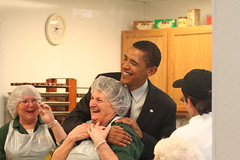
Oh Mama, Obama


IMG_6942
Originally uploaded by Barack Obama
OK, another "News in Brief" on the fly et cetera.

I was exploring my Flickr site when I discovered Barack Obama has a site, well not quite "like everyone else" - but, it made me laugh out loud and do a double take.

So, I made him a contact. (I'll see if he clicks back.)
You might enjoy the look-see your own self.

God, I love the Internet.
Makes my consciousness seem totally grounded.

Zen Stories, now and then


temple disconnection
Originally uploaded by cjb22

Knowing that we are looking for something we already have and are does not, of course, mean that the journey is
unnecessary, only that there is a vast and sublime joke
waiting to be discovered at its end.
Andrew Harvey, 'The Direct Path'

So, off I tramp. Much a do about nothing, all around the mulberry bush.
Becoming a scientist was never much in doubt. They love to hypothesize and think -
always with the question.

Zen Story One: How Grass and Trees Become Enlightened

One day a fifty-year-old student of enlightenment said to Shinkan: "I have studied the Tendai school of thought since I was a little boy, but one thing in it I cannot understand. Tendai claims that even the grass and trees will become enlightened. To me this seems very strange."
"Of what use is it to discuss how grass and trees become enlightened?" asked Shinkan. "The question is how you yourself can become so. Did you even consider that?"
"I never thought of it that way," marveled the old man.
"Then go home and think it over," finished Shinkan.

I find I do not want to explain myself. No talking it through with the girls.
I am almost sick of words. Almost.
I want to experience and then just let it be.
No labels. No putting it to words.
In labeling I feel a torque.
Is it a twist of fear? Yes.
Is it a twist of “Not True?” Yes.
It is a twist of ego? Yes.

I am almost sick of words. But not quite - damn, I’m blogging still
Still
I am not quite anything.
Best case label, “I am Nothing.”
That is so obvious. Obvious oblivion.
Then there is that torque -
How can I deny: the tree, the table, the sky, the thoughts?
All That must be at least Something. I know that truck can hit me hard.

So that must be something And thus I can’t be Nothing.

But I am.
Nothing.
Staring me in the face
The contradiction is so funny. I laugh hugely, silently
And that is contradiction too
as no grin breaks upon my face.

Rumor had it Angels can dance on the head of a pin.
Maybe I’m an angel… no, that was just a rumor.
More likely, I’m a pin head
Dancing on the Void
Dancing, Dancing
Insisting on the pin head.

Zen Story Two:


Originally uploaded by akiruna
The emperor, who was a devout Buddhist, invited a great Zen master to the Palace in order to ask him questions about Buddhism.
"What is the highest truth of the holy Buddhist doctrine?" the emperor inquired.
"Vast emptiness... and not a trace of holiness," the master replied.
"If there is no holiness," the emperor said, "then who or what are you?"
"I do not know," the master replied.

What is there is know? I have the words and theory down
pat
No wonder I have a tendency to headaches. The problem is with my eyes, connected as they are to brain.
One of these days I’ll have to give up science.

Whoever knows that the mind is a fiction and devoid of
anything real knows that his own mind neither exists nor
doesn't exist. Mortals keep creating the mind, claiming
it exists. And arhats keep negating the mind, claiming it
doesn't exist. But bodhisattvas and buddhas neither
create nor negate the mind. This is what's meant by the
mind that neither exists nor doesn't exist...

The Zen Teachings of Bodhidharma, translated by Red Pine

“Ugh,” I say. “Ugh.”
Stepping ever closer to giving up on words. One day I’ll have to give up blogging.

Zen Story Three:
A Zen Master lived the simplest kind of life in a little hut at the foot of a mountain. One evening, while he was away, a thief sneaked into the hut only to find there was nothing in it to steal. The Zen Master returned and found him.
"You have come a long way to visit me," he told the prowler, "and you should not return empty handed. Please take my clothes as a gift."
The thief was bewildered, but he took the clothes and ran away.
The Master sat naked, watching the moon.
"Poor fellow," he mused," I wish I could give him this beautiful moon."

Sunday, March 30, 2008

One Day


Marigold and Crane
Originally uploaded by Seeking Tao

Two white, a blue, and brown
one day I’ll forget the combination
exchange the brown for blue.
Even now my mind becomes confused.

I do not know that it matters.
A blue pill
A brown pill, the white
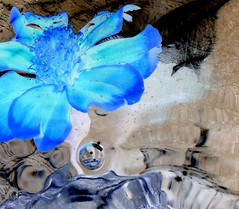
I am reminded of a painting
a white bird in a bubble
floating under a petal by the rocks

Layer within layer

Always something
until Silence insists on Nothing

taking my medicine.


P Bralley.

Friday, March 28, 2008

News in Brief


Lantern Waterfall
Originally uploaded by bandicoot86
My picture "Fall Magnolia" is in this month's issue of qarrtsiluni. This online journal was started in part by Beth Adams, who does such a wonderful job with The Cassandra Pages.

Check it out.
And enjoy yourself.

Wednesday, March 26, 2008

Pain-Body (Part Four): Remembering Winter

…every emotional pain that you experience leaves behind a residue of pain.
It merges with past pain and lodges in your mind and body.
This accumulated pain is a negative energy field, and if you look upon it as an invisible entity in its own right, you are getting quite close to the truth…

The pain-body usually has a collective as well as a personal aspect…
The collective one is the pain accumulated in the collective human psyche over thousands of years through disease, torture, war, murder, cruelty, madness…

Eckhart Tolle

My question is, “How is this possible?”
How is it possible to inherit what’s essentially a memory?
That should be impossible.
I should not actually “remember” what happened to my grandmother.
Yet, Tolle says we bear the scars and thus is some sense the memory.

Years ago my brother told me of a study in which mice were put on a zinc deficient diet. Their descendents had depressed immune systems for the next five generations – even when zinc was restored to normal levels.

To Andy, these results not only showed the importance of proper nutrition
but also had implications for all of us today.
Since there has probably never been a time when five generations have all received adequate nutrition, we must all still bear the marks of our ancestors’ deprivation.

Five generations.
That takes us back to great-great grandfathers.
In my case, these are the Bralley and Kearfotts who fought the Civil War.
In my case, when Andy mentioned the nutrition research, I was plagued by "flashback" of wars I hadn’t been alive to see.

So, I liked the idea of trans-generational memory even if it was just nutritional.
But then, it hit me.
“That is Lamarkism. And, That Can’t Be!”
Darwin shot that all to pieces.
“Acquired traits” like memories or nutritional status cannot be inherited,
and pain-bodies should not be possible.

Yes, I know. There is Nurture as well as Nature.
Psychological damage does get passed from one generation to the next.
But, Tolle seems to be describing something physical, something sounding almost genetic.
He is talking Nature.

So let’s lay aside for the moment the psychological impact our parents’ traumas.
Let’s also set aside the possibility that information may be “immaterial” - encoded “in our souls.”
Are there still factors creating an inheritable pain-body?

“Every emotional pain that you experience leaves behind a residue of pain”

I think this is what Tolle’s saying. There is something physical that gets created and inherited.

Which brings me back to, “How can this be?”

Maharishi, called it stress:
an emotional overload that changes our physiology and bodies.
Marahishi said that stress creates a knot. (A knot of what he did not say.)

Now we know that Post Traumatic Stress Disorder affects the hippocampus (seat of memory) and HPA axis (hypothalamus, pituitary, adrenal axis - brain signals breaking out into the entire body).
PTSD also gives you flashbacks as memory replays in waking nightmares.

…But, how…
How could the traumatic memory be passed on to future generations?
How could I know what it was like to be a soldier in a war I never fought?
I could I develop PTSD from a war I was never in? (which is one way of describing my struggles for over twenty years after I awakened in 1975.)

I have mulled these questions over for several decades now.
It was only last month that I came across a journal article on plants entitled:
Remembering winter: toward a molecular understanding of vernalization.

Oh!
If plants “remember winter” then surely brains are not required.
But, of course! This is exactly the point in the PTSD refrain, “the body remembers.”

The article on plants went something along these lines:
Exposure to the cold of winter is an important cue for flowering in spring.
Flowering is due to cold-mediated modifications of proteins in the chromatin
This process is known as vernalization


which is just the technical way of saying plants recall the cold by modifying the proteins that entwine their DNA.
Memories don’t always require a brain.
And molecular information is not solely stored in the genes (which is the Darwinian position and the geneticist’s and my prejudice).

Information can be stored “epigenetically.”

Remember that word.

Epigenetics makes it possible to inherit acquired traits
(like the depressed immune systems of mice on low zinc diets.)
Epigenetics makes it possible to remember winter
(like a rose covered by the snow.)
Epigenetics can be trans-generational.
Epigenetics puts an end to protests of “Lamarkism!”
Epigenetics explains how “memory” can be inherited.

For Example:
Swedish men born in 1905 who experienced famine just before puberty, had grandsons who went through puberty earlier and had lengthened life spans.
Grandsons of the well fed had shortened life spans and increased diabetes.

For Example:
The World War II food embargo imposed by Germany on Holland caused 30,000 deaths.
The descendents of survivors suffered a range of health problems inlcuding: diabetes, obesity, coronary heart disease, cancer, as well as smaller-than-normal grandchildren.
Our bodies can remember that grandmother nearly starved.

Not That I have Proved a Thing


in the window
Originally uploaded by dianabog
From a biological perspective none of this proves anything.
It’s no where close to really nailing down Tolle’s statements about the pain-body.
But, it puts us in the ball park.
One - Memory need not be confined simply to the brain. The body can remember.
Two - The impact of events (call it memory for short) can be inherited.

I find all of this exciting, even radical.
Radical? You say.
Yes!
And germane to those interested in understanding the mechanics of spiritual cultivation and enlightenment.

Realizing who you are is a piece of cake compared to living it.
It is a freebie.
You don’t have to do a thing for it, you don’t have to change, and you don’t have to alter anything…
Just relax and do nothing, go nowhere, and be nobody just for a split second – and grace shows you who you are …

When you want to live this awakening, you realize it will cost you.
The cost is your fixated point of view…
The cost is your resentment, blame, and judgment.
Adyashanti

The cost is the dissolution of your pain-body.
And that is something that you have to work at.
This is how we let go of all fixated views and ego.
So best we understand what the pain-body is, how it is created,
and what dissolving feels like.

Let me say this in another way:

For the past one hundred years biologists have held the view that as a caterpillar changes into a butterfly or moth, it essentially dissolves into a soup.
In its new incarnation the butterfly not only has an entirely different body, but also a whole new lifestyle, diet, and ecological niche.

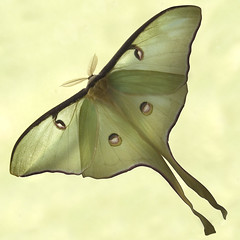
Recently however, scientists have shown that a moth can remember what it learned as a caterpillar.
To be specific: Shock a caterpillar when it smells a certain chemical and later the moth will avoid that odor.
The moth can recall its conditioning- what it learned essentially in its “previous life” as “worm.”
Perhaps this learning/memory is stored in small pieces of neurocircuitry that remain intact in the soup. There are hints of this, but even so, it is a radical concept that old memory circuits survive the dissolution and are then re-integrated in the new nervous system.

This is so radical an idea that I am tempted to wonder that perhaps even caterpillars have a “soul” - something that records life lessons, not unlike the brain-dead subjects mentioned in Allan Hamilton’s book, The Scalpel and the Soul.

So, do butterflies have pain-bodies?
Do butterflies have flashbacks?

My god, the humiliation of remembering that once you were a worm!
Spiritual evolution can be ruthless in its search for truth.
Are butterflies not even spared?

I can empathize, as I recall the time in the fourth grade when I was forbidden to take recess with the other children.
My penmanship was so terrible that my teacher insisted I stay at my desk carefully writing out over and over again:
The worm one of the lowest forms of animals crawls on its belly.

“May I go to recess now?”
“No!”
Obviously, it was a lesson on “w,” “l” and “m”
I, however, took it as an opportunity to create one more bit of personal pain-body.

Which may, or may not, inspire a reinterpretation of this classic lesson:
The great Taoist master Chuang Tzu once dreamt that he was a butterfly fluttering here and there.
In the dream he had no awareness of his individuality as a person.
He was only a butterfly.
Suddenly, he awoke and found himself laying there, a person once again.
But then he thought to himself, "Was I before a man who dreamt about being a butterfly, or am I now a butterfly who dreams about being a man?"

(Any explanations will be welcomed.)

Monday, March 24, 2008

The Scalpel and the Soul


Knife
Originally uploaded by Seeking Tao
This is a blog done on the fly.
I have been working for sometime very carefully on a post that is about the pain body and memory without nervous systems ... and getting rather tangled up in the details.

Meanwhile, I happened to visit Dean Radin's blog (Entangled Mines) "just now"... Do you ever go there? I have the link - interesting fellow.
Anyway, he provided yet another link to a neurosurgeon who has written a book, The Scalpel and the Soul.

Trust me. Go there and listen to this man's video!
He's done a much better job than I will ever do with pain body and memory.

And now, I feel as if I am smiling into the camera, holding up my tube of tooth paste for all to see, "Buy some today."
"You'll be glad you did."

No more blogs on the fly? Vote here, under comments.

Sunday, March 23, 2008

Loss and Resurrection: Happy Easter, 2008.


Easter, 1952
Originally uploaded by Seeking Tao
When Pop died in 1996 it was if the Universe conspired for a while to really drive home the point of Loss.

First, a burglar too not only all of our electronics, but also my jewelry box.
That box contained an assortment of little presents Pop had given me.
Mostly they were items I never ever wore because they were “all wrong:”
A pair of shiny redwood pins shaped into “PB.” (Would an 9 year old wear those?)
A silver, turquoise and coral inlaid Zuni Indian dancing with a black obsidian snake gripped between his teeth that I simply found grotesque.
A string on large agate beads, never formally strung. (Great for a matronly neck, but I was 15 at the time.)
An antique black opal ring from Italy – which I thought beautiful, but after I’d destroyed Grandma’s garnet ring (my one inheritance from her) in about a week’s time, I hesitated
to wear anything of real value.

Maybe it wasn’t so much a jewelry box as it was a haven for each somewhat “unfortunate” object, every one of which precious by the simple fact it came straight from Pop’s love.
I hardly ever wore them. But from time to time, I’d sit with them. I’d turn each one carefully, ponder each, and remember.

That was gone, now – forever.
No more holding. No more touching.

We moved on to planning Pop’s Memorial.
I wanted to use some of the Dixieland music that he loved.
He had had a large collection of records carefully transferred to reel-to-reel tape.
Poppy loved a party and he taught us all about good true jazz, and just how to rattle the bones, which he could do two handed.
He filled our house with Dixieland and celebration.
play Alphonse Picou and High Society.
This particular rendition was perfection, to me “a classic” that embodied both joy and heart break.

Well, Mom had warned me, but I hadn’t believed her.
I was welcome to have a look, but the tape recordings had disappeared years ago.
The records had been ruined more recently in a flood from the garage, though she still had a box or two.
My hopes crumbled along with one after another of the album covers.
I managed to salvage a couple records, but
I still ended up in tears, kneeling there amidst the hopeless decay.

No more listening. No more singing along.
No more High Society. No more Alphonse Picou.
But, this is an Easter message.
And my theme this past week has been something about redeeming what is lost, and the growing realization that we are all in this together.
So, voila! ...

Surprise, delight, and joy – I have found Alphonse Picou on YouTube.
Here’s a clip from around 1959 from the last years of his life.
Alphonse Picou plays his clarinet solo in High Society.
The tempo seems a bit slower than I recall.
The video is low resolution.
But, you still hear that potent mix of joy and pathos that slay me as a kid.

Viewed 10,754 times and counting in the last year.
Alphonse Picou and his music are not lost.

Here’s for you, Mom.
And for you, Pop.
For big sister Sandy and little brother Andy.
And for all of you “out there” … Happy Easter.

Friday, March 21, 2008

Tibetan Culture


Tibetan culture
Originally uploaded by Nathanael.Archer
This is a photo posted today from France, by one of my Flickr contacts, Nathanael Archer.

Nathaneal and I share an interest in calligraphy... and now, I find, Tibet and the Dalai Lama.

I wanted to draw your attention to his suggestion that we educate ourselves about the Tibetan culture. What a good suggestion and positive action.

Sadly too, his image and suggestion brought to mind the situation in Ray Bradbury's novel, Fahrenheit 451. Faced with a society that banned and burned all books, people saved them by committing them to memory...

Taking them to heart.
Seems we are being called to many lessons: non-violence, diversity, and love.

Thank you, Nathanael.

Non-violence and the Small Voice of Truth


Hole II. Rameswaram
Originally uploaded by
entrelec
That still small voice said, “Don’t do it. It’s not for you.”
Did you listen?
You didn’t know that was the wisdom of the universe, did you?
You didn’t know that was the enlightened Buddha nature (prajna) giving you a gift of grace, right?

The beauty of truth is that truth never insists.

The truth that comes to you from the inside is known, but does not insist.
This is why it can be thrown away so easily and effortlessly.
You don’t have to listen to it.
Adyashanti

You don’t have to listen, because Love is patient and this Truth speaks of the eternal.

Yesterday, I asked how it could possibly be that the non-violence of the Dalai Lama could ever win out over the guns and tanks of Chinese brutality.
Here-in lies the answer: The Dalai Lama is following the small voice of the truth that never insists, the wisdom of the Universe.
Because of this, Truth is irresistible in its non-resistance.

This Truth expresses itself through all the laws of Nature.
And Nature dwarfs anything that man can come up with.
Nuclear Winter? The Universe says, “Alright.”
Let’s have 10,000 years without sunshine and then gradually a new balance will arise. Yang will come from Yin… invariably, in time.

The Universe doesn’t insist that we master our lessons at any particular pace, in any particular manner.
Seems to me it just nudges us along, setting up the consequence, which is actually the counter-balance to whatever choice we make.

Adya puts a sign on the door of his retreats: “Resistance is Futile.”
It prompts an explanation once again, so perhaps this time we’ll get it.
“That which we resist persists.”
We draw to us that which we push away.

I was in a taxi once, on the back roads of India, when the driver suddenly pulled over and announced he was stopping for a rest.
There was a tree, a shack, and a yard of grassless dirt - hardly an oasis – but then, this country that was showing me bone crushing poverty. This land had had the life sucked from its soil to an extent I had never seen.

I didn’t want to stop.
The shack was dark, the whole place, suspect.
I didn’t want beggars coming up to me, as they inevitably would, the moment I got out of the car.
I wasn’t leaving my protection, the means of my escape.
I folded my arms and grimaced silently to Becky, “Don’t leave me here alone.”

She jumped out with the driver eager to have a look-see.
They enjoyed a cold soda, a little chit-chat, and good leg stretch before
returning to the car,
which to my utter horror had become engulfed - windows, hood, windshield – by small children pressing against every inch of glass.
Hugh brown eyes and soft red lips were eagerly chanting a surreal lesson, “Pen? Pen? Pen?”

Sometimes, the Universe isn’t the least bit subtle in its delivery.

After what seemed an eternity, Becky climbed back in and started laughing.
The driver took us to our destination… an ashram where we hoped to find the Avatar.
And I now think the car ride was every bit as enlightening as our planned itinerary.

Accept everything, as if you had requested it,” is how Eckhart Tolle puts it.

Adya has redressed any misconceptions, “Accepting does mean condone.”
And neither does Non-violence…
Accepting means you do not resist that which the Universe presents to you.
This is what you get. Now embrace it.

It’s a subtle, high stakes teaching.
I think it takes a Buddha or a Dalai Lama to really live it well.

I think this is our invitation from the Universe.

Thursday, March 20, 2008

The Dalai Lama and Peace

I believe that the very purpose of our life is to seek happiness. That is clear. Whether one believes in religion or not, whether one believes in this religion or that religion, we all are seeking something better in life. So, I think, the very motion of our life is towards happiness… His Holiness the Dalai Lama

The Dalai Lama has his own web pages here at Emory University.
A few years ago he spoke at graduation.
Last October, he came for several days to accept a professorship.
The Drepung Loseling Monastery’s North American seat is an affiliate of Emory University and here in Atlanta.

So, I was not surprised when I received this email yesterday:

At 5 pm today through Friday on the Quad, Tibetan monks will be holding prayer vigils for peace and for their fellow monks in Tibet during this turbulent time.

This past week Tibetan monks and citizens protested the continuing oppressive rule China holds over Tibetan religious rights. The demonstrations quickly escalated as Chinese military police quelled the protesters. Violence ensued. Some reports claim 80 Tibetans died in the turmoil.

Each vigil will last about 20 minutes. All are invited to attend, observe, and respectfully offer support. Thank you!

No, I was not surprised. I turned and looked out my window at the steady rain, the cold gray day, and was sad.
I pictured the monks in their bright ochre robes, standing with bowed heads, and a wet dispirited turn-out of a few students.
I forwarded the email to a friend with the comment that it made me sad.

Morning Edition, March 18, 2008:
The Dalai Lama made a startling threat Tuesday, saying he would step down as the leader of a Tibetan government in exile if protesters in Tibet continued their violent protests.
Later, one of his top aides clarified the Dalai Lama's comments…
Tenzin Taklha said, "He would resign as the political leader and head of state, but not as the Dalai Lama. He will always be the Dalai Lama."

I had heard this sound bite as I did my morning asanas.
The Dalai Lama would step down? How could that be?
And then those words, almost sounding childlike in the trust they held, “He will always be the Dalai Lama.”

Of course! The Dalai Lama is too sweet to be other than who and what he is… at least to me.
Then this morning, as once again I did my asanas, came the next sound bite:


Morning Edition, March 20, 2008:
Chinese officials are ignoring calls for a dialog with protesters in Tibet.
Instead, they have labeled the Dalai Lama a "wolf in monk's clothes" and a "monster with a human face and an animal's heart."


Monster, wolf, animal?

How long does it takes for non-violence to win out?
How can it ever be?
It seems almost a logical impossibility.
And yet, sometimes it does.

My friend emailed me back today.
She had heard from a friend she trusted.
He added this bit of news and a suggestion:

Dear Friends,
On a personal note, my daughter Julie is married to a Tibetan refugee and is now living in Dharmsala, India, residence of the Dalai Lama.
In a call two days ago, she told me that they are getting what seems to be reliable information through family networks about Chinese atrocities that are far worse than what is being reported in the media.
I encourage you to sign this petition and share it with others.
Thanks.

There was this logic offered:
China does care about its international reputation.
Its economy is totally dependent on "Made in China" exports …
it is keen to make the Olympics in Beijing this summer a celebration of a new China


So, I signed.
And I am sharing the petition.
They hope to raise a million voices in unison for peace.

Wednesday, March 19, 2008

Stroke of Insight

I have mentioned before that migraines seem to give me insight into brain function.
It seems that I can actually perceive how information brought in through my eyes is processed by the brain in a stepwise manner.

You’re not supposed to be able to do this:
i.e. “observe the brain from the inside,” as neuroanatomist, Jill Bolte Taylor has said.
But, Dr Taylor has done exactly this, while having a stroke,
when she was 37 and a researcher at Harvard.
Her “stroke of insight” she calls it.

In neurophysiology way back when, I was taught that every sense discards information as it collects input from the world.
The signals that do get through to the brain are then integrated together, step after step, layer after layer, by the sensory cortex.

Beyond the step of collecting light, there are the next tasks:
images are constructed, images are interpreted,
interpretation is linked with memory and the greater context.
It seems that with my migraines, a layer of this processing simply drops out.
And “seeing” no longer works the way it use to.

Seeing no longer feels like seeing.
Seeing doesn’t make the sense it should.
(Senses should make sense? Oh! I would demand that, yes.)
And I am left pawing at my face to remove glasses that I am not wearing, as I scream inside, “I cannot see!”

All this is by way of an introduction to a talk by Jill Bolte Taylor at a recent TED Conference.
She tells quite a moving story… for a scientist and mystic.

And just so you won’t miss it, I excerpt here a comment left by Saeed Dyanatkar in the TED Comments Section:

This is not the first time a scientist is talking the same way as a mystic.
In Persian literature there is a famous story about an occasion in which a mystic (Abu Saeed Abel-kheir) met a scientist (ave Sina) and after a very long exchange of ideas they conclude their experiences for their students:

Ave-Sina: Whatever I know he sees.
Abel-Kheir: Whatever I see he knows.